
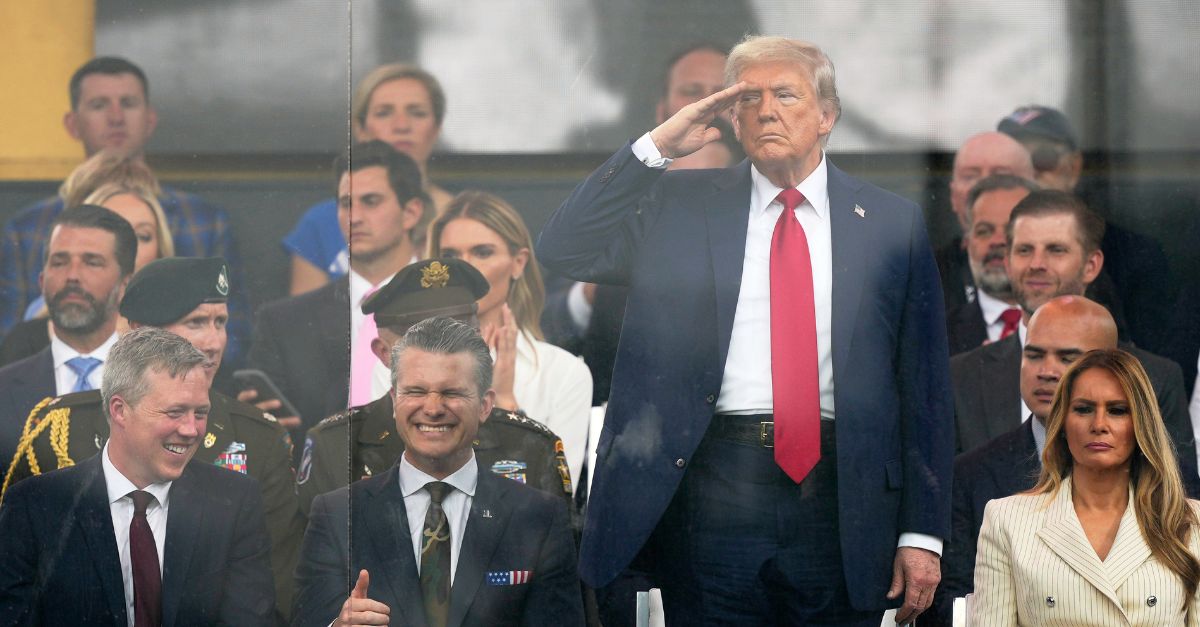
President Donald Trump salutes as attends a military parade commemorating the Army's 250th anniversary, coinciding with his 79th birthday, Saturday, June 14, 2025, in Washington, as Secretary of the Army Daniel Driscoll, Defense Secretary Pete Hegseth, and first lady Melania Trump, watch. (AP Photo/Julia Demaree Nikhinson).
The Trump administration can continue using National Guard troops to police Washington, D.C., a federal court of appeals ruled Wednesday.
In the district's case against President Donald Trump, a unanimous panel on the U.S. Court of Appeals for the District of Columbia Circuit determined the federal government has military purview over Washington, D.C. due to its novel status as a "federal enclave."
In August, the 45th and 47th president ordered the deployment of National Guard troops "to address violent crime and to ensure public safety" within the district, the appellate court's order recounts.
In September, Washington, D.C., sued, alleging a host of constitutional violations, including that the president acted beyond his legal power and authority and that the deployment violated multiple prongs of the Administrative Procedure Act (APA), the federal statute governing agency actions.
Love true crime? Sign up for our newsletter, The Law&Crime Docket, to get the latest real-life crime stories delivered right to your inbox.
At the trial court level, U.S. District Judge Jia M. Cobb, a Joe Biden appointee, conditionally ruled in favor of the plaintiffs. In November, the lower court issued a preliminary injunction but simultaneously issued an administrative stay effective until Dec. 11.
In turn, the Trump administration appealed the trial court's injunction order and moved for a stay pending appeal with the court of appeals — a stay that would almost certainly pause the lower court's order far beyond the original date envisioned by Cobb herself.
Then, in early December, the appeals court entered its own administrative stay pending a further order — effectively dislodging the time-limited administrative stay entered by the trial court.
Now, in a two-page per curiam order, the appeals court has dissolved its own stay and granted the government its requested stay pending appeal. While the order itself is terse and lacking entirely in legal analysis, all three judges explained their reasoning in a statement.
"Because the District of Columbia is a federal district created by Congress, rather than a constitutionally sovereign entity like the fifty States, the Defendants appear on this early record likely to prevail on the merits of their argument that the President possesses a unique power within the District—the seat of the federal government—to mobilize the Guard," the three-judge statement reads.
The statement penned by Circuit Judge Patricia Millett, a Barack Obama appointee, and joined by Circuit Judges Gregory G. Katsas and Neomi Rao, both of whom were appointed by Trump, makes much hay out of the distinction between the District of Columbia and the several states.
To hear the district – and the lower court – tell it, the use of National Guard troops gathered from one state and then deployed to another state against the second state's wishes would raise myriad constitutional issues. And, on that point, the appeals court agreed — with a caveat.
Washington, D.C., again, is not a state.
"Deploying an out-of-state Guard to a non-consenting State to conduct law enforcement would be constitutionally troubling to our federal system of government, and courts no doubt have a duty to construe ambiguous text in statutes to avoid serious constitutional questions," the three-judge panel went on.
The statement continues like this, at length:
But the only issue that was before the district court and is now before this court is whether the President could request such deployments to the District of Columbia, which is not a sovereign State, but instead is a unique federal district that serves as the Capital of the United States and the seat of the federal government. In that specific context, the Defendants are correct that staying the preliminary relief ordered here would not require reading [federal law] to permit a president to call on governors to deploy their Guards into non-consenting States.
The appeals court further opined that the District of Columbia's own laws likely "independently authorize" the troop deployments at issue.
At a basic level, the court found the president has the authority to "order out" the District of Columbia's homegrown guard troops "[w]henever it shall be necessary." But the court did not hang its hat on that general grant.
"More to the point, the D.C. Code contemplates in multiple provisions that the D.C. Guard may be ordered to 'aid the civil authorities in the execution of the laws,'" the statement goes on. "And [another section of D.C. law] allows two Executive Branch subordinates of the President—the United States Marshal for the District of Columbia and the National Capital Services Director—as well as the District of Columbia Mayor, to request that the President order out the D.C. National Guard to address violence in the Nation's Capital."
Cobb, for her part, suggested the above-referenced law mandates that one of those three individuals request the president to take action before deploying the National Guard in the district. The appeals court rejected this understanding of the local law.
"[T]he provision speaks in permissive, not limiting, language that serves to expand the list of who may identify a need for the D.C. Guard's activation," the statement continues. "So [D.C. law] does not displace or limit the President's statutory authority over the D.C. Guard and its Commanding General."

Comments