
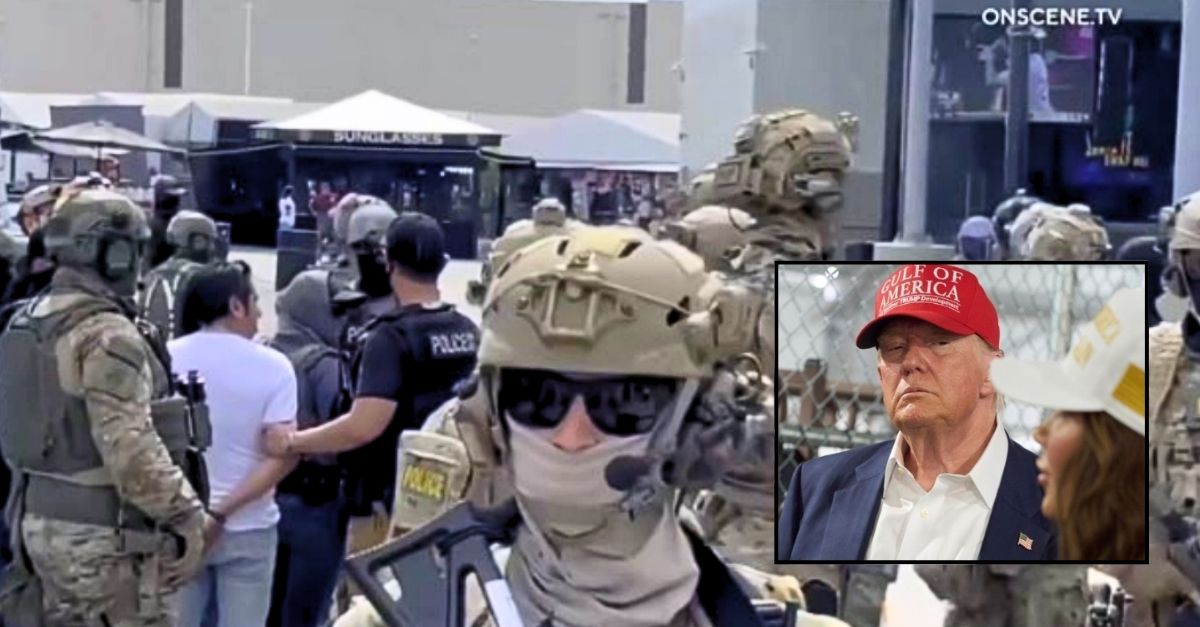
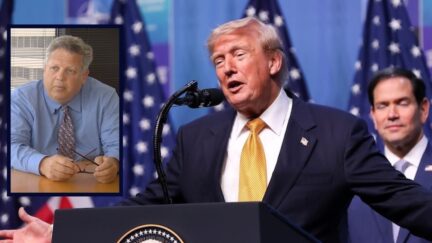
Inset: President Donald Trump listens as Homeland Security Secretary Kristi Noem speaks at the Dade-Collier Training and Transition facility, Tuesday, July 1, 2025, in Ochopee, Fla. (AP Photo/Evan Vucci). Background: ICE agents raiding a Santa Fe Springs swap meet on June 14, 2025 (Onscene.TV/ACLU).
The U.S. Department of Homeland Security recently found itself on the receiving end of courtroom discipline for violating its discovery obligations in ongoing litigation over Immigration and Customs Enforcement (ICE) raids and seizures in Southern California.
In a 15-page order, U.S. District Judge Maame Ewusi-Mensah Frimpong, a Joe Biden appointee, held DHS in civil contempt for "intentionally" withholding forensic images of agents' cellphones.
"Upon review of the parties' submissions and counsel's representations at [a recent] hearing, it does not appear that Defendants' noncompliance is due to an inability to comply," the order reads. "Instead, the clear and convincing evidence shows that Defendants have acted intentionally and not in good faith."
The court's original order on cellphone imaging was issued in mid-January of this year. Since then, the plaintiffs and the defendants have gone back and forth on various issues – including the entire universe of potential phones, the number of agents who use their personal phones for work, and the dozens of agents who "indicated that they would consent to the forensic imaging of their personal phones."
The cellphone-related information was made available to the court during a hearing held in late May, the judge clarifies.
But as of June 29, the Trump administration "had not forensically imaged any personal phones," the order explains.
Notably, the sanctions order was issued in late July – under seal. The court only made the order public earlier this week.
In ruling against the government, Frimpong said the basic question of compliance with her earlier order was an easy call.
"As a threshold matter, at issue is whether Defendants have violated the January 16 Forensic Imaging Order," the order reads. "[T]his Court concludes by clear and convincing evidence that they have, and that they did not substantially comply."
The judge rehashes the agency's obligations [emphasis in original]:
[D]efendants must now conduct a complete and proper search for documents responsive to the RFPs at issue, including . . . [f]orensically imag[ing] any cell phone used by an agent present at any of the 15 operations and review these devices for material responsive to [the relevant production requests.] So, for Defendants to be in compliance with the January 16 Discovery Order, it plainly follows that they would need to have forensically imaged.
Those obligations were skirted for months, the judge said.
"Defendants had not forensically imaged any personal phones as of May 26, 2026," the order continues. "Defendants offered no evidence that this was no longer true. In other words, Defendants have not represented to this Court that they have now started forensically imaging, nor does any of their proffered evidence suggest as much."
For its part, DHS did not contest its lack of compliance. Instead, the agency complained about following the order, the judge noted.
"Defendants' representations, including at the hearing, confirm that they have not complied with the January 16 Forensic Imaging Order," Frimpong continues. "But Defendants have not even partially complied, nor have they provided any estimate of how long they expect it would take to comply. Instead, Defendants repeatedly represent that this process is time-consuming."
The judge expressed little patience with the government's complaints, saying issues about time actually worked against DHS in the case.
Again, the order, at length [emphasis in original]:
[T]he fact that phone imaging would take substantial effort does not relieve Defendants from a court order, nor does it explain why those efforts have still not meaningfully started. If anything, the time-consuming nature of the imaging process makes Defendants' delay less excusable. Assume that each cellphone ultimately takes days to image, and that imaging the phones is a necessary precursor to reviewing them for responsive data. If that is so, then Defendants' failure to begin that time-consuming process is all the more likely to result in delays to this case's schedule.
"The Government has offered no explanation as to the delay for these tasks," Frimpong observed.
Having found that the "elements of civil contempt are met" and that DHS' "noncompliance is intentional," the court entered a "coercive sanction" of $500 per day to be paid to the court "until they fully comply" with the months-old cellphone imaging order.
Frimpong also took the opportunity to opine on what the discovery obligations – and compliance with them – mean within the broader context of the lawsuit against ICE's immigration sweeps.
"From the beginning, the Government has stated that its agents are not unlawfully stopping people," the order reads. "The Government has explained that it had 'reasonable suspicion' for every stop it made. As part of the process of 'discovery,' the people and organizations who brought this lawsuit asked the Government to turn over the communications that the Government agents had regarding the operations…The rules that govern this lawsuit required the Government to search for and turn over the requested material…The Government did not properly search for this material."

Comments