
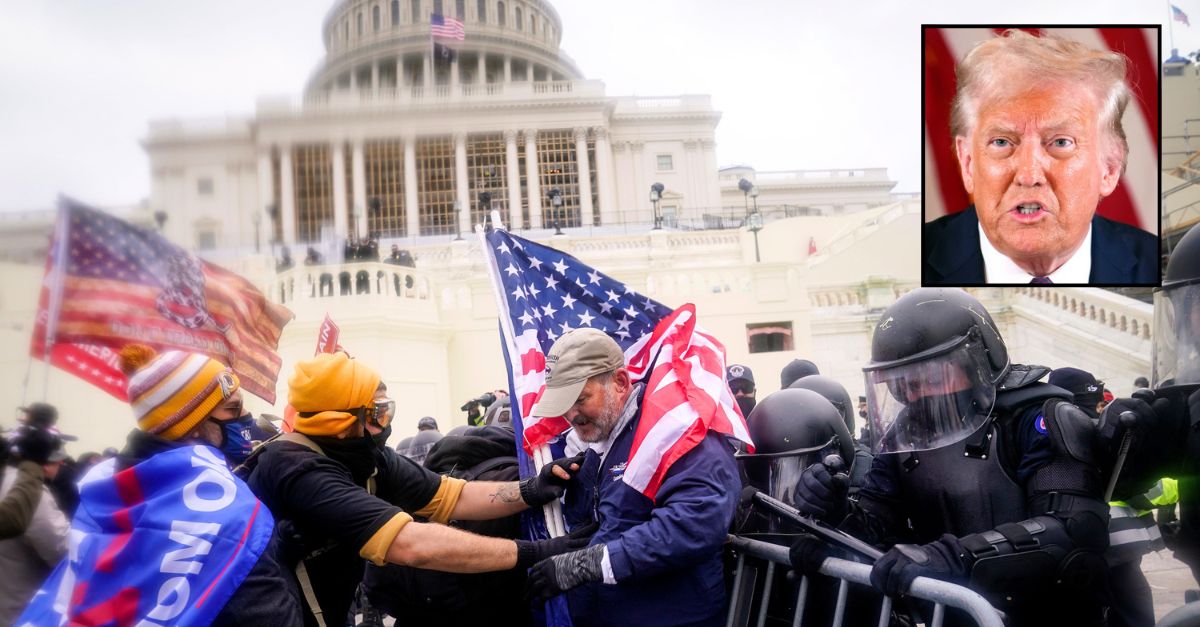
Inset: Then-President-elect Donald Trump speaks during a meeting with Republican governors at Mar-a-Lago, Thursday, Jan. 9, 2025, in Palm Beach, Fla. (AP Photo/Evan Vucci). Background: Rioters try to break through a police barrier at the Capitol on Jan. 6, 2021, in Washington. (AP Photo/John Minchillo, File).
The U.S. Department of Justice is telling at least some Jan. 6 defendants they have simply waited too long to file lawsuits claiming damages allegedly caused by federal law enforcement's response to the pro-Trump riot.
In one underlying case, plaintiffs Patrick Sullivan, Marie Sullivan, and Alan E. Fischer III allege that police injured them through the use of "indiscriminately launched explosive munitions, chemical agents, and impact projectiles" outside the U.S. Capitol on Jan. 6.
The 15-page Sullivan-Fischer lawsuit, on its own terms, is premised on the Federal Tort Claims Act (FTCA). The statute allows individuals to sue over damages caused by the tortious acts of federal employees and, in certain express circumstances, can even waive immunity for members of law enforcement who commit such violations.
Now, the Trump administration says the events of Jan. 6 have far exceeded the FTCA's statute of limitations – at least in terms of trying to seek compensation through the FTCA's private right of action.
In a 15-page motion to dismiss, the DOJ implores the Florida-based court to toss the "purported" class-action lawsuit "with prejudice."
Notably, the motion breezes through the heart of the plaintiffs' allegations – reciting the allegations against the government without commenting on their veracity.
Instead, the motion to dismiss is all about process and time. The DOJ argues these points – procedure and lapsed timelines – in tandem.
"Fast forward approximately four years and eight months, the United States Capitol Police receive two letters enclosing (in total) 30 individual administrative claims complaining of injuries received on January 6," the motion reads. "However, the submitted forms were only partially completed, did not have proper signatures, and did not include supporting documentation."
From the outset and repeatedly, the DOJ makes sure to stress exactly how long the plaintiffs waited to file their "excessive force" allegations — first by way of the aforementioned, and allegedly deficient, forms and then, finally, by filing their FTCA lawsuit.
"Now, over five years after the alleged incident, the Named Plaintiffs have filed the purported class Complaint," the motion goes on.
Under the FTCA, a would-be plaintiff must present their claim in writing to the appropriate agency "within two years after such claim accrues," the government says, citing the statutory language.
Such written claims can come by way of a specific form created for the express purposes of the FTCA or in an "other written notification" which is accompanied by a claim for damages — that is, a lawsuit.
Here, however, the plaintiffs waited far past the two-year mark to file their written administrative claims or their lawsuit, the motion says. That means their litigation is fatally deficient, according to the DOJ.
"Notably, if the tort claim is not properly presented within the time period, it 'shall be forever barred,'" the motion goes on. "There is no question that none of the administrative claims were timely filed."
The government's filing all-but belabors the timelines, at length:
Here, the Named Plaintiffs allege that they were injured by the police actions that occurred on January 6, 2021. Thus, the Named Plaintiffs' deadline to file the administrative claim was January 6, 2023. However, the earliest claim of the Named Plaintiffs was dated July 29, 2025. This was over two years after the deadline to file the administrative claim with the relevant agency. Accordingly, all the claims in the Complaint are "forever barred" due to the failure to timely file…
The motion to dismiss also challenges the process by which the plaintiffs filed their class-action lawsuit – alleging fatal deficiencies. Again, the focus here is on time, however, in a somewhat separate sense.
"Rather than create groups based on the alleged injuries received, the Complaint separates the class members into groups based on whether they had even attempted to comply with the administrative process for FTCA claims," the motion continues.
One group admittedly complied by submitting their claims and waiting the proper amount of time before filing a lawsuit, according to the government. The second group halfway complied by submitting claims but not waiting, the Trump administration says. The third group, for its part, did not comply at all, according to the DOJ.
To hear the government tell it, the court should not hear the class-action lawsuit because the first group's complaints were still filed too late and because the second and third groups are entirely ignoring how the statute works.
"Plaintiffs try to get around this fatal defect for the class complaint by alleging that administrative exhaustion is a simple formality and that it would be futile to require them to do so based on the treatment of the previous claims," the motion goes on. "[T]he Supreme Court, however, has explicitly stated that '[t]he FTCA bars claimants from bringing suit in federal court until they have exhausted their administrative remedies.'"



Comments