
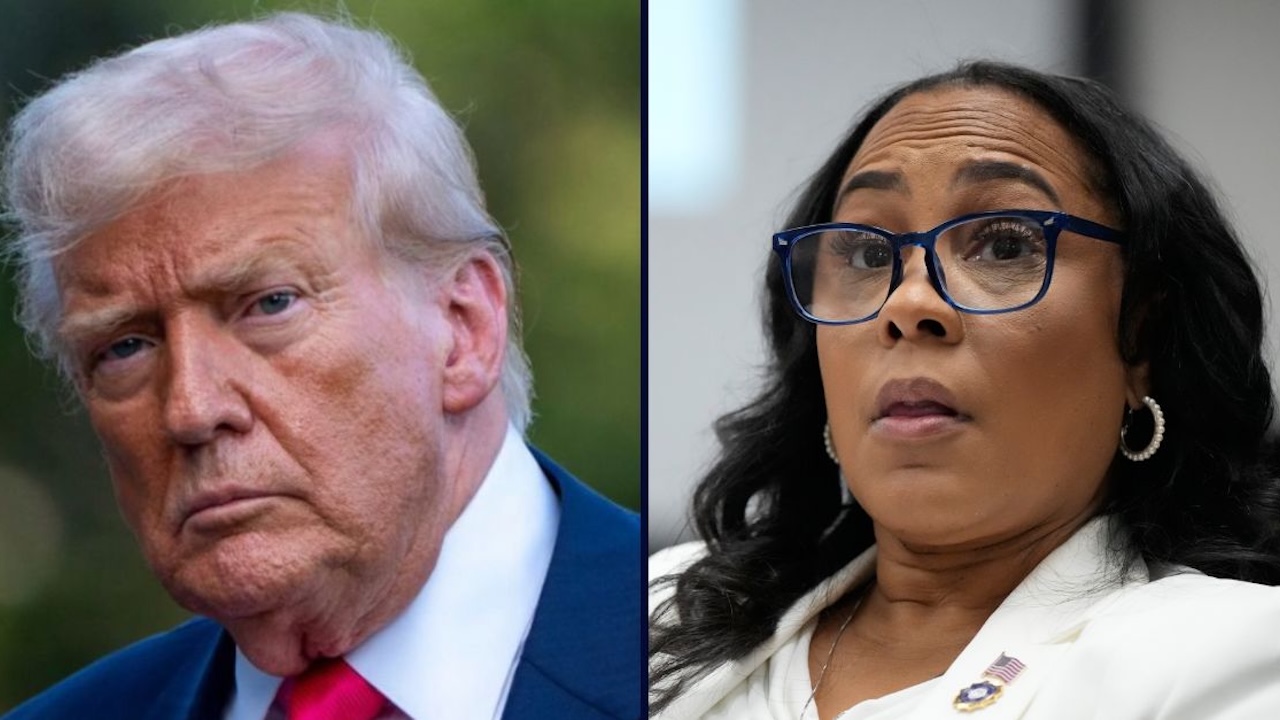
Left: President Donald Trump walks from Marine One after arriving on the South Lawn of the White House, Tuesday, July 15, 2025, in Washington (AP Photo/Alex Brandon, File). Right: Fulton County District Attorney Fani Willis is seen at the Georgia State Capitol during questioning from a Georgia State Senate panel about her prosecution of President Donald Trump on Wednesday, Dec. 17, 2025, in Atlanta (AP Photo/Brynn Anderson).
Roughly two weeks ahead of oral arguments, Fani Willis made her final pitch for intervening as President Donald Trump seeks to recover legal fees over the disqualified Fulton County district attorney's dismissed 2020 election RICO case.
The reply brief, reviewed by Law&Crime, shows that Willis' office is set to argue on Nov. 17 at the Georgia Court of Appeals that the lower court "abused its discretion" by denying her proposed intervention.
According to the brief, Fulton County Superior Court Judge Scott McAfee "committed clear errors" when he said her disqualification from prosecuting the RICO case extended to the fight over "reasonable attorney fees and costs" to be taken out of her office's budget.
In December 2024, the Georgia Court of Appeals ruled in a 2-1 decision that McAfee made a mistake when he gave Willis and her handpicked special prosecutor Nathan Wade, with whom she had a romantic relationship, an ultimatum that one or the other had to go due to a "significant appearance of impropriety."
Instead, the appeals court said, McAfee "erred by failing to disqualify DA Willis and her office" because this was a "rare case" in which the "significant appearance of impropriety" alone meant Willis and her office should be "wholly disqualified."
After the Georgia Supreme Court declined to review and reverse Willis' disqualification from the case, sealing her fate, Prosecuting Attorneys' Council of Georgia Executive Director Peter Skandalakis appointed himself as "District Attorney Pro Tempore."
Less than two weeks later, Skandalakis filed a formal nolle prosequi abandoning the case to "serve the interests of justice."
From there, Trump's lead defense attorney in the case, Steve Sadow, asked the court to order payment of more than $6 million in legal fees and costs, citing a new Georgia law that "shall" entitle the ex-defendant to an award following the elected Democrat's disqualification for her "improper conduct."
Counting the reimbursement motions of other former RICO defendants, the fee sum at stake nears $17 million.
According to Willis' office, however, the DA's disqualification did not "preclude" her from intervening because the legal fees dispute is distinct from the defunct criminal prosecution — and, in any event, Skandalakis "cannot" and did not "adequately" represent Willis' interests.
"The circumstances created by the statute are unique in Georgia law. The DA pro tem remains the representative of the
State's undeniable interest in the criminal prosecution, or he would, if it had not been dropped. But the State retains no interest in the ongoing fee proceedings, which explicitly target Appellant's interests and, at most, Fulton County's as well," the brief said. "While these proceedings arise from an underlying criminal case, they involve separate interests, questions, procedures, and parties (as Fulton County has already been allowed to intervene)."
The Georgia law Trump has availed himself of, Willis claimed, has "forced all parties involved to grapple with novel proceedings that, whatever else they might be called, cannot be described as 'a prosecution.'"
"The statute has created a procedural mess, and whatever else can be said about it, that mess is legally distinct and factually separate from the criminal prosecution from which it arises," Willis' office continued. "Appellant's disqualification from the criminal prosecution does not foreclose its intervention in these proceedings, and the superior court's holding otherwise—predicated as it was on a misstatement of the facts and the law—was an abuse of discretion."
Willis' office, arguing that the statute is "silent on the question of the original prosecutor's participation" in the fee dispute, said the situation is "analogous to a contempt proceeding arising from a criminal trial."
The Georgia Court of Appeals has set oral arguments for 10:30 a.m. on Nov. 17, with Judges Elizabeth Gobeil, J. Wade Padgett and Ken Hodges III on the panel.
Follow Law&Crime:



Comments