
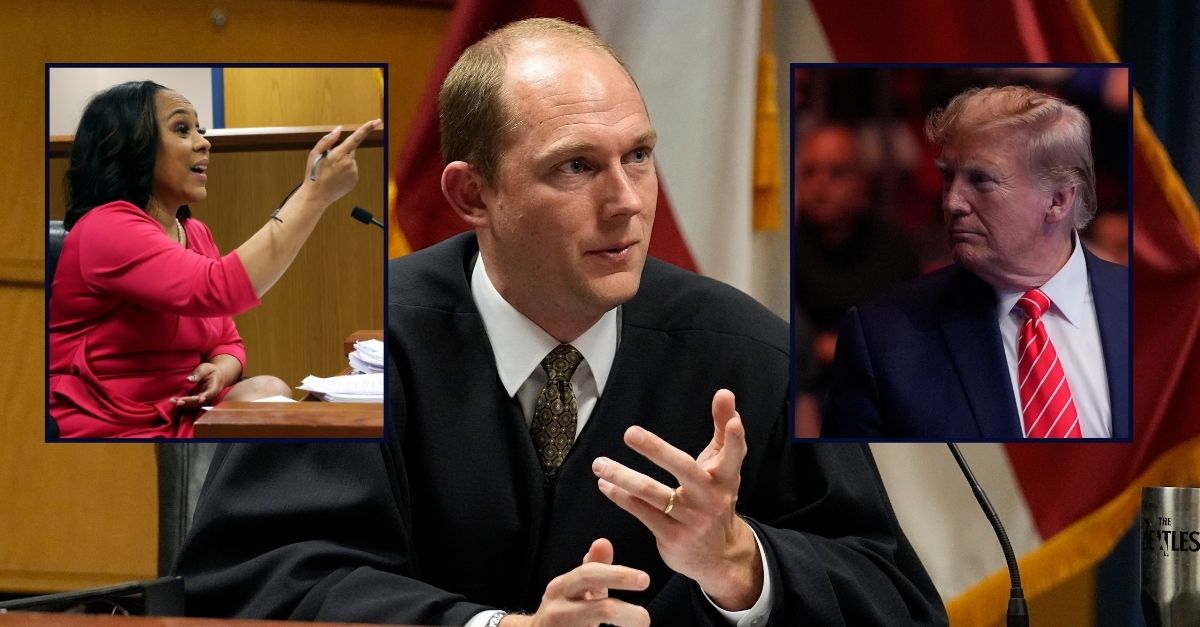
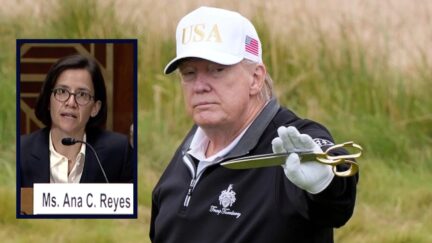
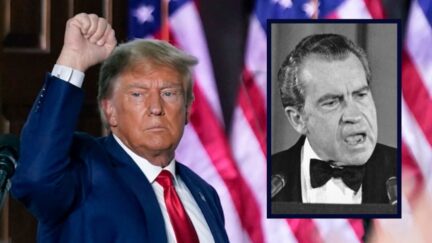
Inset left: Fulton County District Attorney Fani Willis testifies during a hearing on the Georgia election interference case, Feb. 15, 2024, in Atlanta (Alyssa Pointer/Pool Photo via AP). Inset right: Former President Donald Trump waits for the start of a UFC 299 mixed martial arts bout, early Sunday, March 10, 2024, in Miami (AP Photo/Wilfredo Lee). Background: Fulton County Superior Judge Scott McAfee speaks in court, Tuesday, Feb. 27, 2024, in Atlanta. (AP Photo/Brynn Anderson, Pool).
Fulton County District Attorney Fani Willis called Peach State law — and a lower court's understanding of said law — into question as she implored a state court of appeals to let her and her office intervene in yet another case involving President Donald Trump.
In the case, Trump and several of his erstwhile co-defendants sued for some $16.85 million in attorneys fees to recoup legal expenses incurred while defending themselves during Fulton County's failed election fraud and racketeering (RICO) case.
In March, Fulton County Superior Court Judge Scott McAfee reiterated that Willis was "wholly disqualified" from the underlying criminal prosecution. In turn, the court said, that disqualification means she is not allowed to participate in the former defendants' fee dispute.
Now, Willis says the law that allows parties to be reimbursed for such expenses is "an unprecedented and strangely constructed statute that will continue to confound parties and judges alike."
The law, passed in 2025, entitles defendants to a monetary award if a prosecutor is disqualified for "improper conduct."
And, in a 47-page attack on the lower court, Willis says McAfee made several "errors" when interpreting the novel law.
"The ultimate question at issue in this appeal is whether a district attorney's office should be allowed to participate in proceedings that could result in enormous and punitive financial assessments against it," the appellant brief begins. "The superior court in this case answered, 'no.' Instead, the superior court determined that interests of the district attorney's office could be adequately represented by a successor prosecutor whose decision to dismiss an underlying criminal case initiated the punitive proceedings in the first place."
The elected prosecutor was formally removed from overseeing the years-old case in late December 2024, though progress had stalled several months before. On life support in the appellate realm, the RICO prosecution lingered on for months.
In November 2025, the case was finally and forever shuttered in "the interests of justice" by the prosecutor appointed in Willis' absence.
That dismissal set the stage for the various recoupment motions.
Willis claims the judge first erred by assuming, incorrectly, that the replacement prosecutor "can adequately represent the interests of the Fulton County District Attorney's Office."
To hear Willis tell it, the statute outlines two scenarios under which former criminal defendants can begin the fee reimbursement process.
"Neither of those scenarios occurred in the original criminal case here," the brief goes on. "Instead, the DA pro tem assigned himself to the case and then, twelve days later, dropped all charges."
The DA's filing runs through several of the replacement DA's reasons for dropping the case, while noting that in some instances, "charges were dropped without any explanation at all."
"The case was thus dismissed not because of legal insufficiency but because the DA pro tem chose to end it," Willis argues. "These circumstances will not necessarily be present in all proceedings under [the law], but they are undoubtedly present here, and they demonstrate an unavoidable conflict for the DA pro tem as he is asked to safeguard the financial interests of the very prosecutor's office that he placed at risk when he chose to end the criminal case."
The argument here is fairly straightforward. Willis says the person who chose to end the case simply cannot protect the interests of the DA's office.
The brief elaborates [emphasis in original]:
Even if [the elected DA's] interests were somehow identical to the DA pro tem's, intervention can still be authorized when the record contains a "concrete showing of circumstances in the particular case that make the representation inadequate." Between the DA pro tem's doubts as to his authority and expertise, his role in initiation of the fee proceedings, and his public disagreement with the basic premise of the criminal case, such circumstances exist here.
Willis also says McAfee made an even more basic mistake when he determined she was "wholly disqualified" from the matter.
The brief argues the fee dispute matter is "distinct" from the underlying RICO case as well as "ancillary, novel [and] statutorily-created."
Here, the elected DA takes some time to scorn McAfee for what she calls an "inaccurate statement of law extremely specific to this case."
That is, the lower court said the appellate court "determined that a conflict of interest existed." But, Willis says, the whole dispute at the heart of the case was "the significance of an appearance of impropriety versus an actual conflict of interest." On that point, the elected DA says, the lower court "repeats its mistake several times."
"The apparent risk of public confidence in the criminal proceedings that might have arisen from the appearance of some conflict can no longer be an issue, since those criminal proceedings are now over," the brief goes on. "To suggest that such a risk lives on in wholly distinct attorney's fee proceedings, affecting disputes over the reasonableness of expenses that often have absolutely nothing to do with either Appellant or even the guilt or innocence of the former defendants, makes no sense."
Comments