
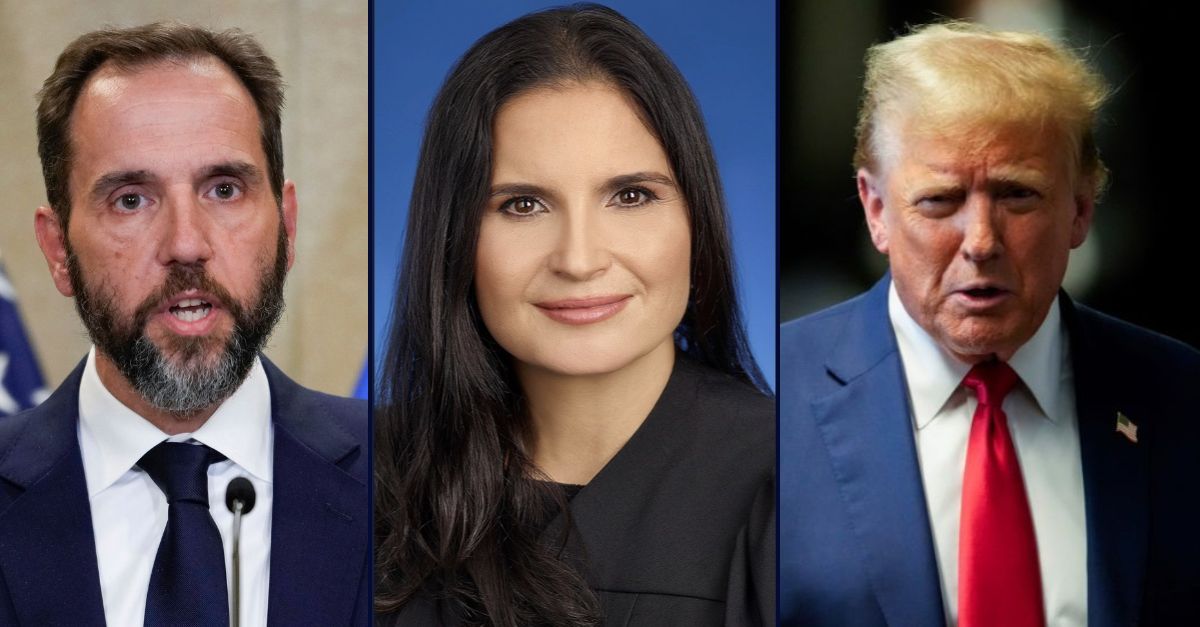
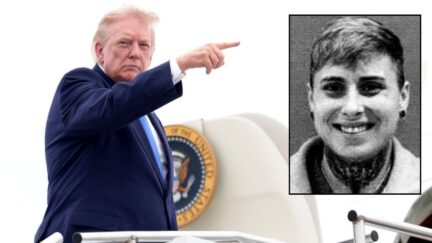
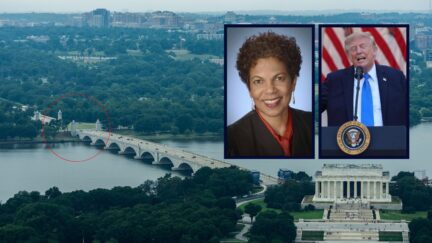
Left: FILE – Special counsel Jack Smith speaks to the media about an indictment of former President Donald Trump, Aug. 1, 2023, at an office of the Department of Justice in Washington (AP Photo/J. Scott Applewhite, File). Center: U.S. District Judge Aileen Cannon (U.S. District Court for the Southern District of Florida). Right: Donald Trump speaks to members of the media before departing Manhattan criminal court, Monday, May 6, 2024, in New York (AP Photo/Julia Nikhinson, Pool).
Time has been on President Donald Trump's side in the tiny Fort Pierce Division of the U.S. District Court for the Southern District of Florida – at least when it comes to the serially delayed yet forever lingering second volume of former special counsel Jack Smith's final report on his investigations into the 45th and 47th president.
Those strokes of luck – good for the president; bad for the onetime prosecutor – are largely due to one woman: U.S. District Judge Aileen Cannon, appointed by Trump during his first term.
On Monday, the judge issued two long-awaited orders offering Trump yet more time to keep the long-secret report under wraps, as well as conflicting outcomes as to how the court will operate in the coming months.
Eleven months and one day in the making, the terse, two-page order following a joint status report addresses the judge's own Jan. 21 order, which prohibited the U.S. Department of Justice from providing select members of Congress with the second volume of Smith's report.
An accompanying 18-page order strictly cabins who will be allowed to argue about what in the coming weeks and months.
In that earlier order, Cannon cited then-ongoing criminal cases against Waltine Nauta, Trump's valet, and Carlos De Oliveira, the Mar-a-Lago property manager, as justifications for keeping the second volume under judicial lock-and-key. Cannon's January order "also directed the parties to file a Joint Status Report within thirty days of the conclusion of all appellate proceedings and/or any continued proceedings" at the district court level, the court's Monday order recalls.
Since then, of course, the DOJ dismissed all the charges against Nauta and De Oliveira – and the docket at both levels in the various cases impacted by the second volume has been dry for months.
In the case against Nauta and De Oliveira at the 11th Circuit Court of Appeals, the last docket entry occurred in January. In the case against Trump, the last entry occurred in February. And, at the lower court level, until a flurry in early December, the last entry occurred in July.
But then, in September, two different groups of litigants filed two technically different (but still related) cases entirely. The Knight First Amendment Institute at Columbia University and transparency-focused nonprofit American Oversight directly petitioned the 11th Circuit for writs of mandamus directed at Cannon herself. Those groups wanted the higher court to force the lower court to rule on their motions to intervene – effectively a sidelong effort to get the ball rolling on the issuance of the second volume.
In late November, a three-judge appellate panel determined Cannon "established undue delay" by declining to respond to earlier motions to intervene filed by the two groups. To that end, the panel gave the lower court a 60-day deadline to finally respond. The upshot appeared to be the appeals court hanging the prospect of that requested mandamus relief over Cannon's head like a time-locked sword of Damocles; if she would not act, they would, maybe.
On Dec. 1, the DOJ and defense attorneys for Nauta and De Oliveira filed a joint status report – largely reiterating their positions expressed in prior submissions that the second volume should never be released due to "the extraordinary prejudice they would suffer" if the report ever left the DOJ. The next day, Trump himself filed a motion to intervene in the case as amicus curiae, taking a substantially similar position.
Cannon quickly allowed Trump his request, and foreshadowed the latest development by adding that "[n]o additional filings" would be "permitted by" the order granting the president's intervention.
Now, the court has ruled as directed by the panel.
Cannon's first Monday order offers a conditional expiration date for her own embargo of the Jan. 21 injunction. The new order says the earlier order "will hereby automatically expire, without further order of this Court" on Feb. 24, 2026. This language, of course, leaves open the possibility that Cannon might change her mind.
In quick succession, Cannon's first Monday order also explained that "any former or current party to this action" may move "for leave to intervene, if warranted, and/or from timely seeking appropriate relief before that deadline." This section appears to be counseling the parties that the court's mind is, perhaps, not entirely made up.
The second Monday order, while considerably longer than the first order, makes short shrift of the outside groups' efforts to intervene.
"Upon careful review of the Motions and the related filings, and fully advised in the premises, the Court sees no basis to authorize nonparty intervention in this closed criminal proceeding—either on the unprecedented and unsupported theory of [Freedom of Information Act (FOIA)] access or on the flawed assumption that Volume II qualifies as a judicial record triggering the common law or First Amendment right of access," Cannon writes.
To hear the judge tell it, FOIA law "does not provide a basis to authorize intervention" for either group due to the nature of the case.
"This theory of FOIA intervention in a criminal case is unsupported in law and unprecedented in scope," the second Monday order goes on. "This is a telling and unsurprising comment on prospective intervenors' FOIA theory—which defies the limits of third-party intervention in criminal cases."
Separately, the groups pushed for the release of the second volume under a combined theory of common law and First Amendment access.
Here, Cannon is withering, at length (emphasis in original):
This theory rests on the necessary assumption that Volume II is a "judicial document" or a "judicial record" subject to the public right of access under the common law and the First Amendment. It is not. No part of Volume II was attached by any party to a substantive motion for resolution on the merits. It was not admitted into evidence or attached as an exhibit to any motion or pleading. It was not filed on the docket (although failure to docket is not alone dispositive in the judicial-document query, to be sure). And no defendant ever maintained Volume II or retained it for submission to this Court as part of their substantive motion.
In the end, both the Knight First Amendment Institute and American Oversight received Cannon's response as requested and directed – just not the one they wanted: a flat direction to take a hike.

Comments