
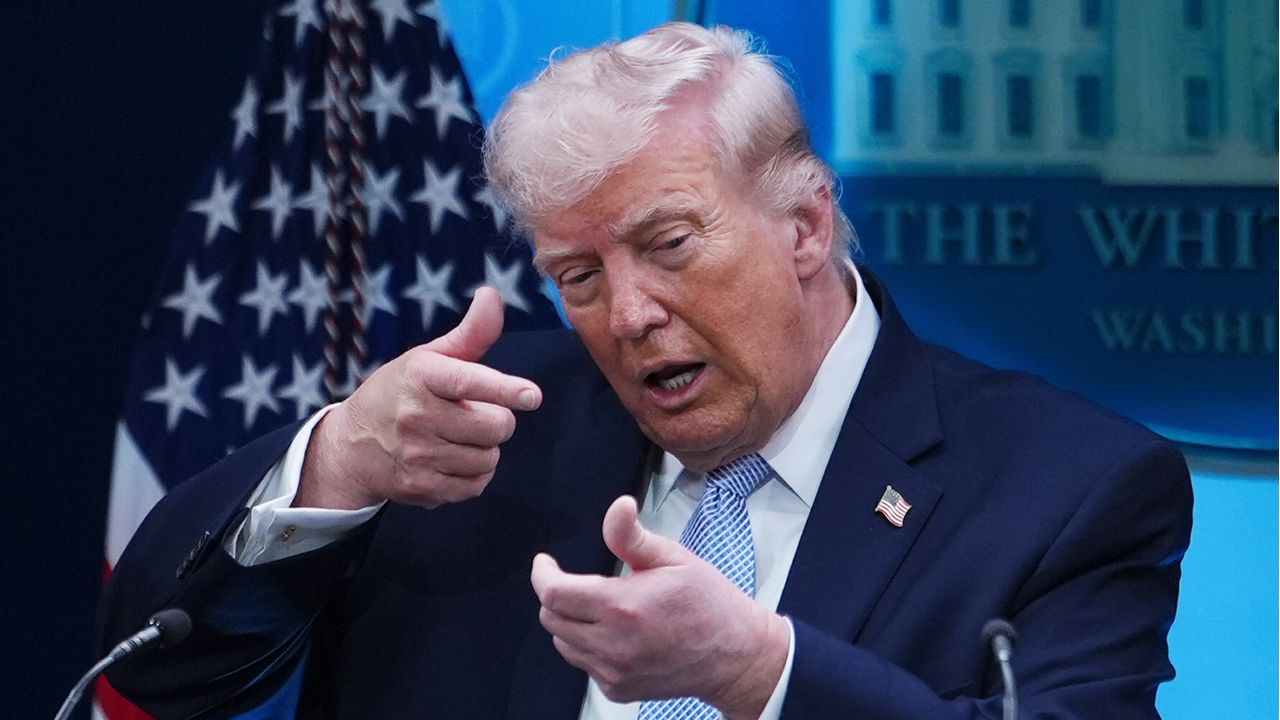
FILE – President Donald Trump pretends to aim a sniper gun while speaking with reporters in the James Brady Press Briefing Room at the White House, Monday, April 6, 2026, in Washington (AP Photo/Julia Demaree Nikhinson, File).
The Trump administration on Friday issued an advisory opinion that declares unconstitutional two federal laws prohibiting firearms dealers from selling handguns to young adults under the age of 21.
The 49-page guidance document was prepared by T. Elliot Gaiser in the Department of Justice Office of Legal Counsel (OLC) and is directed to the attention of U.S. Attorney General Todd Blanche.
"In sum, because the modern federal age restrictions limit young adults between the ages of eighteen and twenty from obtaining arms, they 'fall within the plain text of the Second Amendment' and are 'presumptively unconstitutional,'" the OLC opinion reads.
The specific laws at issue are contained within two subsections of 18 U.S.C. §922 and ban licensed gun dealers from selling "any firearm or ammunition," unless rifle- or shotgun-related, to anyone "who the licensee knows or has reasonable cause to believe is less than twenty-one years of age." A companion statute requires sworn, age-affirming statements for certain non-over-the-counter handgun sales.
Now, the DOJ is essentially putting prosecutors and courts on notice that the government considers those provisions unenforceable.
"Our laws deem an eighteen-year-old 'mature enough to be drafted, vote, serve as a juror, and be sentenced to death,'" Gaiser wrote. "One such eighteen-year-old represented the United States at the Tokyo Olympics in 2020, shooting skeet. Yet, due to statutes predicated on concerns over an eighteen-year-old's ability to handle a pistol as a responsible adult, it would have been a federal felony if a licensed dealer had sold her such a firearm before she left or after she returned to her studies at the University of Texas at Arlington."
The OLC opinion comes on the heels of developments in Second Amendment jurisprudence.
In late June, the U.S. Supreme Court decided the case of Wolford v. Lopez. The opinion penned by Justice Samuel Alito found unconstitutional Hawaii's law prohibiting "licensed concealed-carry permit holders from carrying handguns on private property open to the public without the property owner's express authorization."
The OLC says the age restrictions "single out a subset of firearm transactions for special burdens that are inapplicable to other articles of commerce." Such restrictions are a "mismatch" that parallels Wolford, producing a gap that is "just too wide," the OLC argues.
"Here, the gap runs in the opposite direction but is no narrower," the opinion goes on, rubbishing arguments for applying the legal concept of "infancy" to gun sales for 18- to 20-year-olds. "A rule of contract law that applied to all types of commercial transactions is proffered to justify a ban with criminal penalties that targets only firearm sales."
The OLC opinion also comes the day after the Trump administration signaled it would not appeal a district court ruling that found unconstitutional certain regulations on silencers, short-barreled rifles, and short-barreled shotguns.
That lower court opinion, penned by U.S. District Judge James Wesley Hendrix, a Trump appointee, was not referenced by the OLC.
The advisory opinion also references a 2024 ruling from the 8th U.S. Circuit Court of Appeals that found unconstitutional a Minnesota state law that limited gun-carrying permits to applicants who are at least 21 years old.
"It would be incongruous to require eighteen- to twenty-year-olds to register for selective service and stand ready to carry arms in the Nation's defense, while denying them the core Second Amendment right to bear arms in self-defense," the OLC opinion continues. "Whatever force the common-law infancy doctrine might once have had, '[r]eading the Second Amendment in the context of the Twenty-Sixth Amendment unambiguously places 18 to 20-year-olds within the national political community' today."
The OLC opinion, while straightforward in its conclusions, is not legally binding on any court or prosecutor and does not carry the weight of precedent.




Comments