
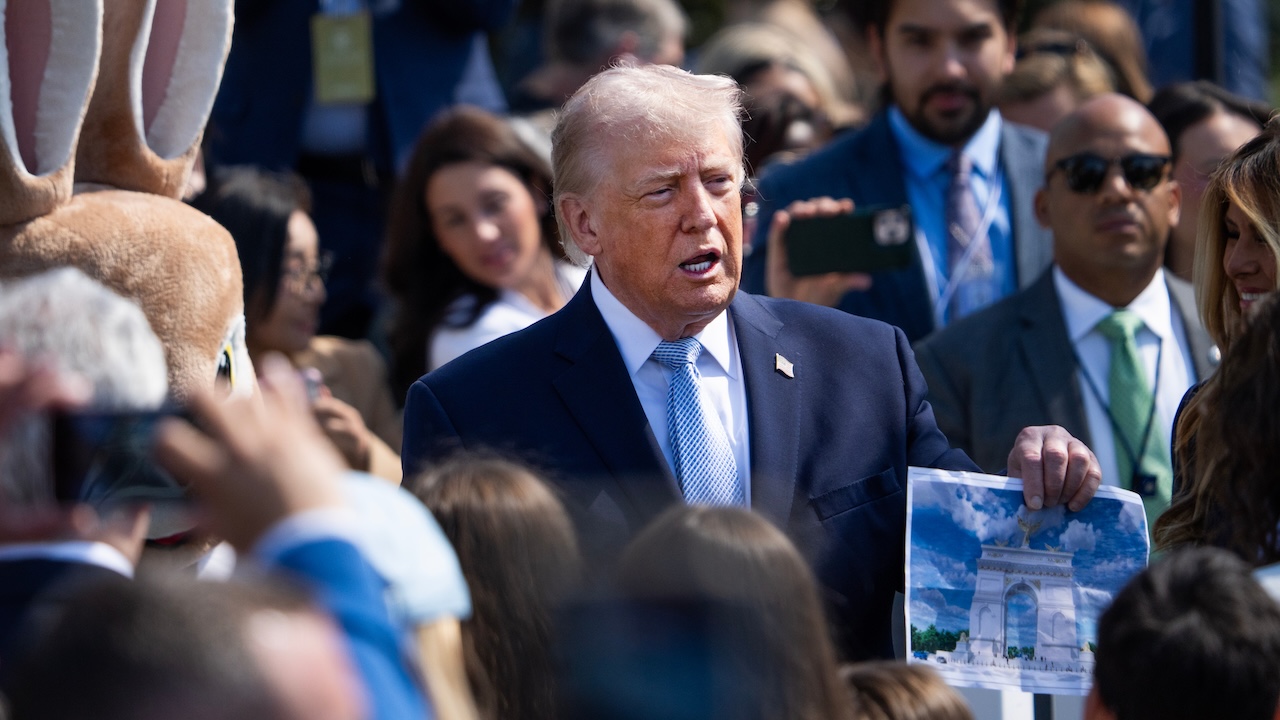
President Donald Trump holds a picture of the proposed Triumphal Arch, on the South Lawn during the White House Easter Egg Roll on Monday, April 6, 2026 (Tom Williams/CQ Roll Call via AP Images).
The Trump administration late Friday implored a federal court not to issue a second preliminary injunction barring construction of a "majestic" 250-foot arch spanning a traffic roundabout near the entrance to Arlington National Cemetery.
In a 44-page opposition motion, the U.S. Department of Justice urged the Eastern District of Virginia — the district court famously referred to as the "Rocket Docket" in the legal community for the speed with which it adjudicates cases — not to rule in favor of the plaintiff.
"Plaintiff lacks standing and, even if it could establish standing, the arch fulfills a century-old congressional vision authorizing the redesign and construction of 166-foot-tall columns surmounted by statues at that site," the government's motion reads.
In its 35-page lawsuit filed in early October, the County Board of Arlington County, Virginia, complained that the Trump administration "has made it a priority to remake the physical landscape of the Nation's Capital in President Trump's image and based on his whims, destroying treasured public spaces in the process."
To hear the board tell it, the planned arch, in three causes of action, runs afoul of the Administrative Procedure Act (APA), the statute governing the behavior of administrative agencies. Specifically, the board says the National Park Service (NPS) performed a "cursory and conclusory" environmental review not in accord with federal law.
Earlier this month, the plaintiff filed a 42-page motion for a preliminary injunction, stressing the timeliness of putting a pause on construction.
"This Arch will dwarf Paris's Arc de Triomphe and directly obstruct the sight line between the Lincoln Memorial and Arlington National Cemetery that was deliberately created to symbolize the nation's post-Civil War reunification," the injunction request reads. "NPS's decision is unlawful and should be enjoined so the agency cannot begin potentially irreparable ground-disturbing activity while this litigation is pending."
Now, the DOJ says the board has no business suing at all.
"Plaintiff lacks Article III standing," the opposition motion reads. "Arlington County cannot sue the federal government as parens patriae on behalf of its citizens."
Here, the government is attempting to ridicule the notion that the board might be trying to sue on behalf of its citizens — a legal doctrine that was recently disfavored by the U.S. Supreme Court.
"Plaintiff therefore cannot establish standing by relying on longer commutes, decreased private property values, aircraft noise, diminished appeal of recreational areas, the County becoming a 'less desirable place to live,' or other injuries allegedly suffered by Plaintiff's residents who are not before the court," the opposition motion continues — listing several of the board's objections to the arch.
The plaintiff, for its part, earlier conceded the traffic circle is in Washington, D.C., "but is located on the Virginia side of the Potomac River and contiguous to the County itself, directly abutting County land."
The federal government says that's not enough, arguing the board's claimed harms are the kind of "indirect effects" that are too "attenuated" to provide a plaintiff with "sufficient injury" for standing.
The opposition motion also attacks the injunction request on the merits of the broader case. "NPS has authority to build the Arch under the 1925 Authorization Act and NPS's Organic Act," the DOJ motion continues. "When Congress authorizes a project 'in accordance with' plans set forth in a report to Congress, the Executive Branch generally has 'considerable discretion' to modify aspects of the project's design. And here the 1925 Authorization Act expressly specified that the Commission had discretion to make changes."
The opposition motion elaborates here:
Plaintiff is thus wrong that the Authorization Act does not authorize the Arch. And Plaintiff is wrong that the Authorization Act precludes design updates, such as an arch of 166 feet plus statues on top instead of columns of 166 feet plus statues on top. The original pylons envisioned at the Washington entrance to the bridge gave way to gold equestrian statues; the "stately columns" "surmounted by statues" can also give way to a different element on Memorial Circle under the Act's authorization to make design changes "as in its discretion may be found to be necessary or advisable." Plaintiff has not shown otherwise.
"Plaintiffs' disagreement with the agency's decision, however strongly felt, does not establish illegality, irreparable harm, or any other need for a preliminary injunction," the DOJ says in a summary section.
For now, at least, construction is not in the offing.
And jurisdictional standing issues are likely to be an issue in all litigation going forward. That is, not just in the present case.
The day before the board filed its original petition, U.S. District Judge Tanya Chutkan, a Barack Obama appointee, issued a temporary restraining order for plaintiffs. In that case, the plaintiffs include both the federal district and Old Dominion itself.




Comments