
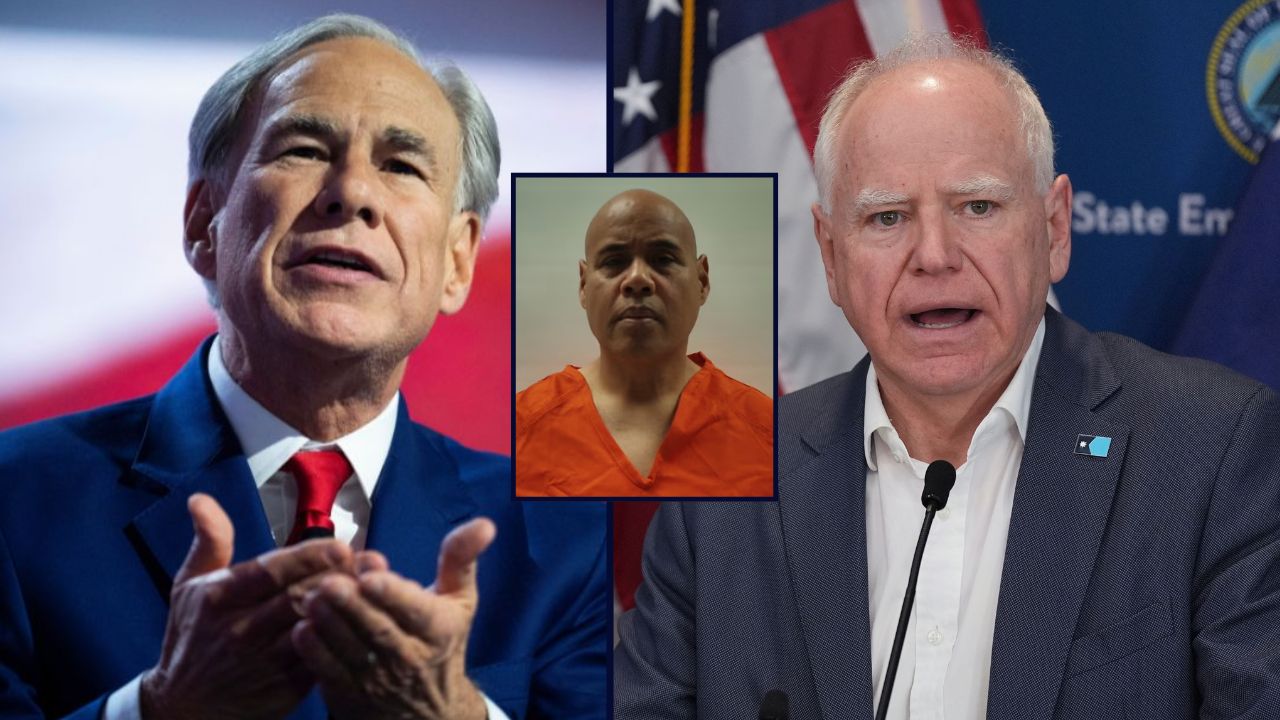
Left: Texas Gov. Greg Abbott speaks in the Fiserv Forum on the third night of the Republican National Convention in Milwaukee, Wis., on Wednesday July 17, 2024 (Tom Williams/CQ Roll Call via AP Images). Right: Minnesota Gov. Tim Walz discusses the shooting of Alex Pretti during a news conference in Blaine, Minn., Sunday, Jan. 25, 2026 (AP Photo/Abbie Parr). Inset: Christian Castro (Cameron County Sheriff's Office).
An Immigration and Customs Enforcement (ICE) agent accused of shooting and injuring a man in Minnesota is currently behind bars in Texas and the focus of a legal battle between the two states.
Since January, ICE agent Christian Castro has been wanted in the Land of 10,000 Lakes on a warrant alleging four felony counts of assault with a dangerous weapon and one misdemeanor count of falsely reporting a crime, according to authorities in Hennepin County.
In May, Castro was arrested by law enforcement in the Lone Star State honoring a nationwide warrant, and a judge in Cameron County ordered the agent to be detained pending extradition proceedings.
But since then, action in the case slowed considerably.
"Minnesota Governor Tim Walz promptly sent a request for Castro's extradition, including a governor's requisition warrant, to the Office of Defendant Texas Governor Greg Abbott," a lawsuit filed on Aug. 18 by Minnesota Attorney General Keith Ellison reads.
The 19-page original petition argues that Minnesota's extradition request "triggered a mandatory obligation" under the U.S. Constitution, federal law, and state law in Texas.
"Instead of promptly fulfilling his ministerial duty to execute a governor's rendition warrant for Castro, as he has done routinely in response to extradition requests throughout his term in office, Governor Abbott has withheld the rendition warrant and held up Castro's extradition for nearly three months," the lawsuit goes on.
That same day, Minnesota filed a 19-page motion for a temporary restraining order, arguing that Texas has a "ministerial duty" to deliver Castro across state lines and requesting mandamus relief.
Motions practice has been quick and voluminous.
On Monday, Abbott responded in court for the first time with a 39-page motion opposing Minnesota's bid for emergency relief.
"Whether Mr. Castro is a fugitive who triggers any mandatory extradition obligation is the very question Governor Abbott is endeavoring to determine," the Texas governor's first filing reads.
Outside court, Abbott sang an entirely different tune in a statement provided to media last week on the heels of the federal court overseeing the lawsuit scheduling an extradition hearing.
"I got a demand of my own, and that is, it's time for Minnesota to step up and repay the United States of America and Americans for all the fraud that they have committed in their state under federal programs," Abbott said. "I will not respond to them at all until they step up and do what's right."
But Abbott did respond.
On Tuesday, the Texas governor filed a 38-page motion to dismiss, offering largely procedural issues for why the lawsuit must fail.
To hear Abbott tell it, the ultimate decision in the matter is his and the lawsuit is an "effort to short-circuit" his "deliberations," which means the dispute is simply not ripe for adjudication by a court.
The Texas governor further argued that Minnesota lacks standing.
"Minnesota has no concrete injury at all," the motion to dismiss reads. "Its theory of harm rests on the false premise that if Mr. Castro is released when the period of preliminary detention expires, Minnesota will lose its opportunity to obtain his extradition."
Abbott also insisted that the U.S. Supreme Court "is the only appropriate venue for this dispute between" the two states.
Finally, Abbott said Minnesota's request, at least at present, fails on the merits — in an argument dovetailing with the process concerns.
"A century of Supreme Court precedent and the plain meaning of the Extradition Clause require the Governor to determine for himself the existence of a set of predicate facts to trigger the extradition obligation based on evidentiary proof," the motion to dismiss continues. "As a matter of law, Minnesota's effort to rush the Governor's deliberations—and unilaterally deem Mr. Castro to be a fugitive—cannot establish any 'ministerial' duty to undergird a mandamus claim."
During a hearing this week, U.S. District Judge Fernando Rodriguez Jr., who was appointed by President Donald Trump, seemed averse to ruling in Minnesota's favor in the near term.
The two states are also arguing over Castro continued detention.
Minnesota claims the agent is a potential flight risk because he left Minnesota and has not returned. Texas says it is possible — and likely — that he traveled to Texas because ICE moved him there.
Abbott has also dismissed the flight risk argument as implausible in light of a federal investigation into Castro announced Monday.
"Minnesota rushed to file this lawsuit, claiming (incredibly) that an ICE agent subject to ongoing federal investigations—and who never bothered to post bond—was somehow a flight risk to Mexico because he 'is fluent in Spanish,'" the motion to dismiss goes on.
The judge seemed to be choosing the Texas perspective on the flight risk issue, saying he was "not inclined" to order the sheriff's office to hold Castro past Thursday, The Texas Tribune reported.
Rodriguez also signaled that he was unlikely to try to force Abbott to speed up the investigation into whether Castro qualifies as a fugitive. The court is expected to issue an order this week.



Comments