
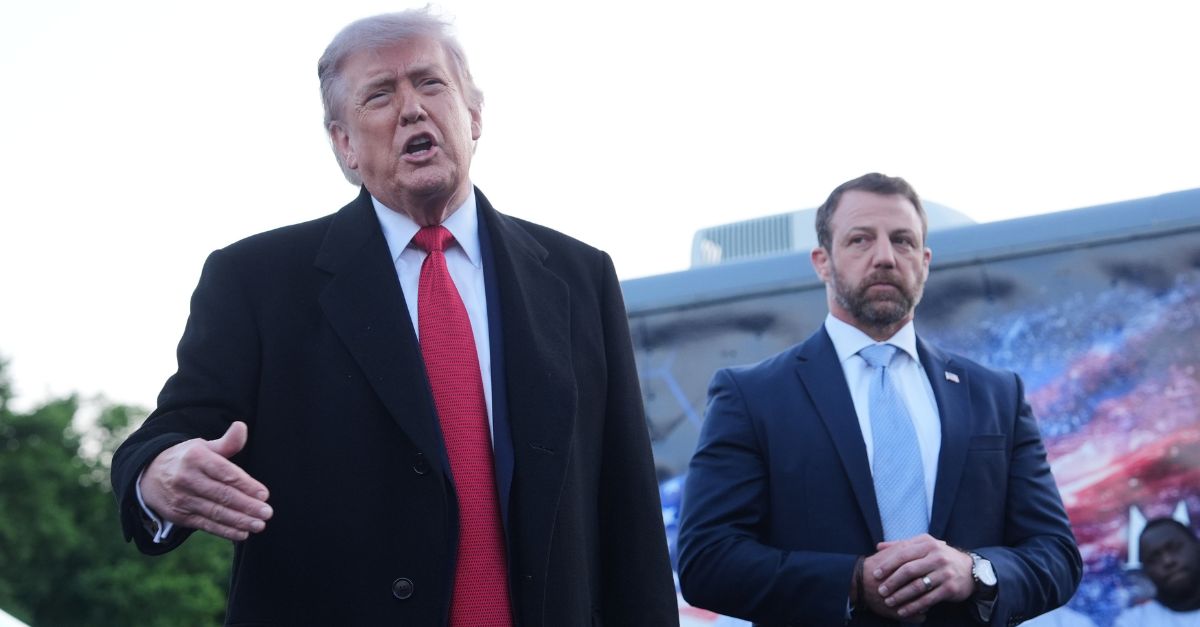
President Donald Trump speaks as he visits the Lincoln Memorial Reflecting Pool to see the new blue protective coating being applied as part of a renovation project, Thursday, May 7, 2026, in Washington, as Homeland Security Secretary Markwayne Mullin listens (AP Photo/Mark Schiefelbein).
A federal judge in Nevada recently called out Immigration and Customs Enforcement (ICE) and other immigration authorities for "lawless conduct" after they repeatedly violated court orders in numerous habeas corpus cases brought by detained immigrants.
In a 20-page order and opinion, U.S. District Judge Richard F. Boulware II, a Barack Obama appointee, harshly upbraided Trump administration officials for their behavior generally and specifically in the case of seven detained petitioners who collectively sued for release in May.
The joint petition for the writ of habeas corpus relied on recent precedent in the Silver State — a March ruling also penned by Boulware that found the Department of Homeland Security's (DHS) policy of mandatory indefinite detention to be unconstitutional.
In July 2025, DHS and ICE issued the policy — breaking with decades of precedent — in a memo instructing agents to deny bond to anyone who entered the country without "inspection" and triggering a wave of litigation as thousands of detainees have filed habeas petitions. Under the policy, such immigrants are to be detained "for the duration of their removal proceedings" unless granted parole, a rarer form of release. In real terms, however, the Trump administration had made clear such detentions are intended to be indefinite.
"Defendants' policies, which unearth a vast but hidden mandatory detention authority in a long extant statute, subject millions of people living in the U.S. to prolonged detention," the judge wrote in March.
Boulware's earlier opinion also contained a lengthy appendix of habeas cases to which the ruling was relevant — instructing DHS to make sure such detainees are freed and aware of their rights.
That apparently did not happen.
"[T]he government, which has yet to file an appeal in [the March ruling], is disturbing the longstanding assumption that Executive Branch officials and departments will comply with a declaratory judgment unless and until it is stayed or vacated," the opinion reads. "More fundamentally, the government is rebelling against the basic principle underlying our constitutional order that 'an order issued by a court with jurisdiction over the subject matter and person must be obeyed by the parties until it is reversed by orderly and proper proceedings.'"
Disposing of the seven petitioners' case with a final judgment, the court found the detainees to be class members covered by the March ruling and said that their continued detention "is unlawful and violates this Court's declaratory judgment and vacatur."
But the ruling also goes much further — issuing a prophylactic series of orders due to the government's behavior and posture about the reach of its claimed detention authority under federal law.
The government claims ICE has the authority to subject immigrants to mandatory detention under 8 U.S.C. §1225(b), which applies to "aliens seeking entry into the United States." Advocates for immigrants — as well as most judges who have ruled on the matter — have instead turned to 8 U.S.C. §1226(a), which applies to "aliens already present in the United States."
Boulware made quick work of those statutes — reiterating that the government's claimed authority is wholly illegal and even limiting the applicability of the statute widely assumed to be more viable.
From the opinion, at length:
[T]he Court finds Petitioners' arrest and ongoing detention without the procedural protections required under § 1226(a) violate their constitutional right to due process. Finally, the Court finds the appropriate remedy for Petitioners' unlawful detention and the government's defiance of the Jacobo-Ramirez judgment is immediate release from custody, a permanent prohibitory injunction against re-detention under § 1225(b)(2)(A), and an order requiring Federal Respondents to follow appropriate procedures in the event they seek to re-detain Petitioners under § 1226(a).
The judge goes on to chastise the government for its "open defiance" and threatens contempt should violations of court orders continue.
"In the absence of the threat of contempt, Federal Respondents have made clear that they will not conform their conduct to the [March] judgment voluntarily," the opinion continues. "The consequence is not that the lawfulness of Petitioners' detention is uncertain—this Court has already adjudicated it—but that Petitioners require an appropriate remedy in this habeas proceeding, backed by the Court's contempt power, to give effect to their clearly established rights."
Boulware then takes stock of the government's actions in other habeas cases — and finds them wanting in the extreme.
"Federal Respondents have engaged in a systemic pattern of noncompliance with this Court's orders in related habeas matters, apparently undeterred by the fact that, in contrast to the non-coercive nature of the declaratory judgment and vacatur, those orders are backed by the Court's contempt power," the opinion continues. "These violations include, inter alia, removing petitioners from the District of Nevada, failing to release petitioners as ordered, disregarding deadlines, failing to provide constitutionally adequate bond hearings, and imposing unlawful release conditions. By violating this Court's orders, Respondents are undermining their credibility and the rule of law."





Comments