
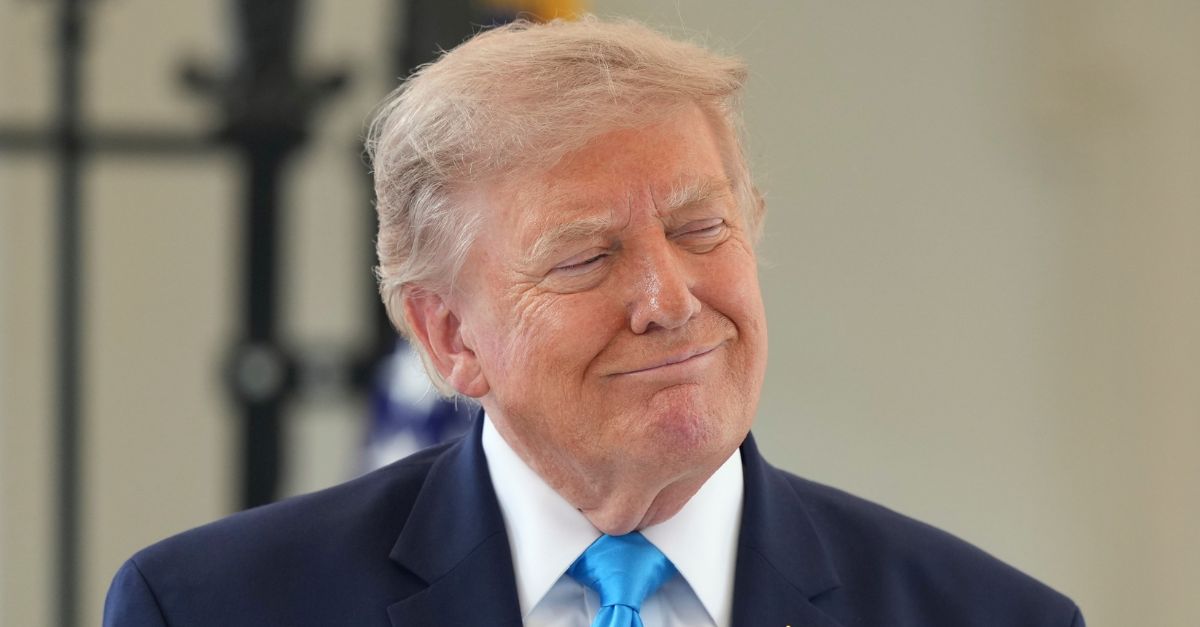
President Donald Trump listens during an event to announce the Freedom Haulers initiative at the White House, Thursday, July 30, 2026, in Washington (AP Photo/Alex Brandon).
Illinois does not have to turn over comprehensive voter registration data to the Trump administration, a federal court ruled this week.
In December 2025, the U.S. Department of Justice sued the Land of Lincoln and its Secretary of State Bernadette Matthews. The lawsuit alleged violations of the National Voter Registration Act (NVRA), the Help America Vote Act (HAVA), and the Civil Rights Act (CRA) of 1960.
In February, the state filed a motion to dismiss. Along the way, the Illinois AFL-CIO, Illinois Alliance for Retired Americans, and Illinois Federation of Teachers filed motions to intervene — which were granted by U.S. District Judge Colleen Lawless, a Joe Biden appointee.
On Friday, the judge ruled in the defendants' favor in a 14-page opinion that grants a motion to dismiss the lawsuit while also rubbishing the DOJ's motion to compel production under the CRA.
"[T]he Court finds Title III does not provide the Attorney General with the authority to compel production of the unredacted voter registration list, and the written demand was deficient as a matter of law," the opinion reads.
In ruling against the government, the court accepted the state's argument that the underlying statute simply does not authorize the DOJ to demand the granular voting data at issue.
To hear Lawless tell it, the Trump administration simply tried to twist the words of the statute beyond their "ordinary English" meaning.
The opinion explains the statute in context [emphasis in original]:
Under Title III of the CRA, the Attorney General is authorized to demand only those records held by an election official following an election that "come into his possession," and are "requisite to voting in such election." … "Come into possession" is a synonym for "obtain," "acquire," or "receive." As used in Title III, the phrase does not encompass records that state election officials create or merely possess. Instead, the election officials are required to preserve records that come into their possession from outside sources.
Here, the court makes clear that while the elections board "possesses the list by its own creation," the board "did not come into its possession" and therefore the cited laws simply do not apply.
"If Congress had meant 'come into possession' to simply mean any record existing within the election official's 'possession,' it would not have chosen to include the ostensibly extraneous language," the judge goes on.
Lawless also dinged the DOJ on another issue.
"Dismissal is additionally warranted because the Attorney General's written demand did not include both a sufficient basis and legitimate purpose for requesting the unredacted voter registration list," the opinion goes on.
In other words, the Trump administration both cited the wrong statutes and incorrectly invoked the statutes it cited in service of its often-failed effort to obtain state-level voter data.
The federal government's effort to obtain voter rolls in Illinois is of a piece with a broader effort across the country.
The Trump administration ultimately filed 30 such lawsuits after being rebuked by state officials. To date, however, the government has lost 16 of those lawsuits. Results in the other 14 cases are pending.
Voting rights advocates welcomed the court's decision.
"This ruling is another decisive rejection of the federal government's attempts to bypass its limits of power," Ethan Herenstein, a staff attorney with the ACLU's Voting Rights Project said in a press release. "The Trump administration cannot manufacture a voter fraud crisis to justify a sweeping up of sensitive personal information from millions of Americans."





Comments