
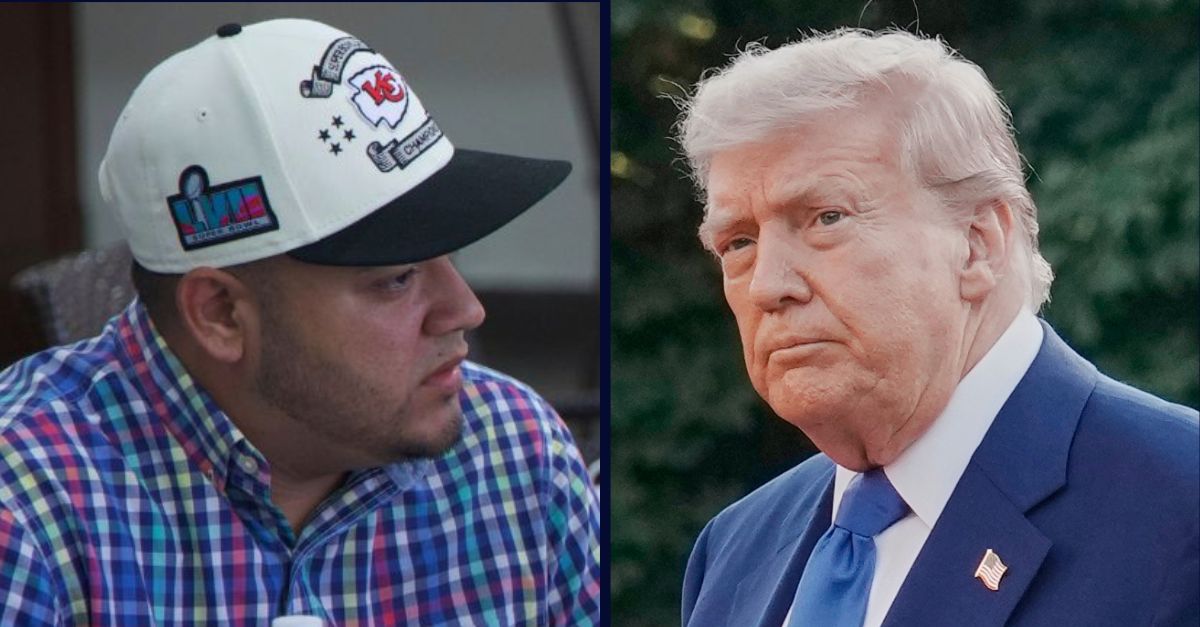
Left: Kilmar Abrego Garcia speaks in a hotel restaurant in San Salvador, El Salvador, Thursday, April 17, 2025 (Press Office Sen. Van Hollen, via AP). Right: President Donald Trump arrives for a formal dinner at the Paleis Huis ten Bosch ahead of the NATO summit in The Hague, Netherlands, Tuesday, June 24, 2025. (AP Photo/Markus Schreiber).
The U.S. Department of Justice wants the U.S. Court of Appeals for the 6th Circuit to reinstate the failed criminal case against Kilmar Abrego Garcia for alleged human smuggling in Tennessee.
In a 71-page opening brief on Monday, the Trump administration asked the appellate court to overrule a lower court order that dismissed the case for selective and vindictive prosecution.
In May, U.S. District Judge Waverly Crenshaw Jr., a Barack Obama appointee, said the case against the Maryland father of three was an instance "of picking the person first and the crime second."
In tossing the charges filed in the Tennessee federal system, Crenshaw said "objective evidence" showed that without Abrego Garcia's "successful lawsuit" challenging his illegal deportation to El Salvador, the government "would not have brought this prosecution."
Now, the Trump administration insists that is simply not so.
"[T]he decision to seek an indictment against Abrego Garcia for human smuggling was made by career prosecutors based on the evidence, the law, and their firm belief that there is proof beyond a reasonable doubt that Abrego Garcia had committed the offenses charged," the DOJ said in a press release announcing the appeal.
In the court filing, the DOJ argued the lead prosecutor in the criminal case "lacked a cognizable stake" in the earlier deportation case.
The brief refers to the high-profile deportation — in which dozens of men were airlifted to a notorious Salvadoran prison in violation of numerous court orders — as "a separate civil case in a faraway district." The filing argues Acting U.S. Attorney for the Middle District of Tennessee Robert McGuire "separately began investigating" the 2022 traffic stop that led to Abrego Garcia's smuggling charges.
"Tellingly, the district court did not even purport to analyze McGuire's stake in that civil case," the brief reads. "Instead, the court appeared to attribute a stake to the Executive Branch writ-large by adopting an unprecedented 'vindictive taint' theory. Ultimately, the district court's reasoning demonstrates why it is never appropriate to presume vindictiveness with respect to an initial charging decision."
In the dismissal order, Crenshaw said the "prosecutor's subjective good faith does not cure the retaliatory taint" caused by then-Deputy Attorney General Todd Blanche's "public statements tying the reopened investigation to [Abrego Garcia's] successful lawsuit."
The DOJ claims the district judge misapplied the law because the only "personal" motive relevant is the prosecutor's. And when it came to the prosecutor, the court "never found that McGuire was not the ultimate decision maker." Rather, the "court believed that McGuire was 'unknowingly' influenced by others in the Executive Branch."
"With McGuire's motives not directly in question, the district court looked to the Executive Branch writ large to fill in the gap," the brief goes on. "That approach fundamentally misunderstands the presumptive-vindictiveness doctrine."
The filing elaborates [emphasis in original]:
The court essentially reasoned that because Abrego had provided some insufficient (as even the district court recognized) evidence of actual vindictiveness based on loose characterizations of public and Executive Branch communications, the presumption should apply to compensate for that weakness and shift the burden to the government to disprove the court's suspicions. That is not how the narrow doctrine works.
As a secondary argument, the DOJ claims that Crenshaw's understanding of presumptive vindictiveness is a bridge too far beyond the "limited scope" envisioned by the U.S. Supreme Court.
"[T]he district court's broad and amorphous conception of presumptive vindictiveness would dangerously expand that doctrine, necessitating unwarranted probing of the mental states and motivations of government officials and inviting courts to usurp the prosecutorial discretion constitutionally committed to the Executive Branch," the brief continues.
The filing stresses that courts simply cannot encroach in this area.
"[T]he court focused on the fact that the government did not charge in 2022, as if the decision to charge in 2025 could be explained only by vindictiveness," the brief goes on. "[C]ourts have no authority to second-guess a delay in the timing of charging decisions beyond applying recognized statutory and constitutional constraints."
The Trump administration also argues Blanche said nothing inappropriate when he commented on the case.
"Blanche's statements highlight the prosecution's legitimate purposes," the brief continues.
To hear the government tell it, Blanche was merely offering informed commentary based on the "timeline" of Abrego Garcia's "pending return to the country" when he mentioned the DOJ's "responsibility to protect the American people and to keep our country safe."
"Blanche's references to the result of prior litigation and judicial statements made in that litigation do not reflect a vindictive motive," the brief goes on. "At a minimum, nothing in his interview supports an inference that the United States pursued charges 'solely' to retaliate against Abrego for his civil suit. The district court's contrary reasoning—which did not even address the full quotation—is illogical and clearly erroneous."
Comments