
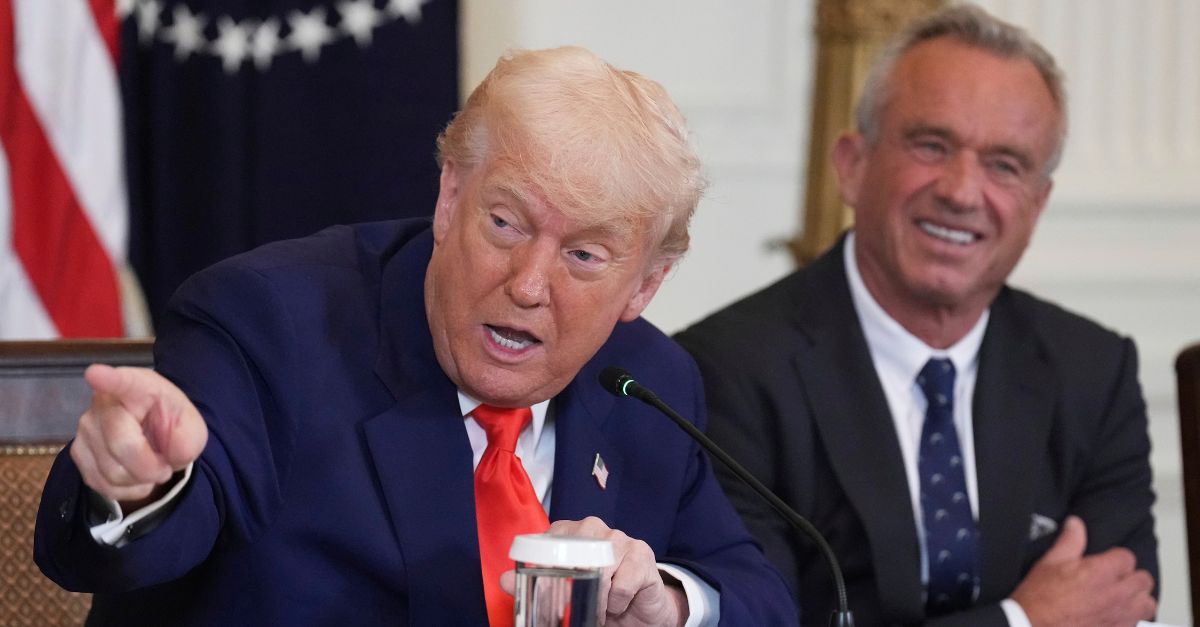
President Donald Trump, left, speaks as Health and Human Services Secretary Robert F. Kennedy Jr. listens during a Make America Healthy Again (MAHA) Commission Event in the East Room of the White House, Thursday, May 22, 2025, in Washington (AP Photo/Jacquelyn Martin).
The Trump administration on Tuesday suffered a setback in its efforts to shutter a previously expansive office dedicated to processing Freedom of Information Act (FOIA) requests.
In a 31-page memorandum opinion, U.S. District Judge Timothy J. Kelly, who was appointed by President Donald Trump during his first term, denied the government's motion to dismiss the lawsuit originally filed by Citizens for Responsibility in Washington (CREW), a nonpartisan nonprofit government watchdog group.
In April 2025, CREW sued the Centers for Disease Control (CDC) and the Department of Health and Human Services (HHS), as well as top officials at each agency, over the FOIA office closure. Next, CREW asked for injunctive relief — in the form of forcing the agencies to assign "sufficient personnel and resources" to respond to FOIA requests in a timely manner and generally keep the office operative.
In June 2025, Kelly denied the plaintiff's request for injunctive relief, Law&Crime previously reported. As the case continued, CREW and HHS agreed to stay motions on one subject of dispute, effectively whittling down the litigation in August 2025.
Now, on cross-motions for summary judgment and the government's dismissal bid, the court has issued a double-edged ruling, denying both motions for summary judgment while granting in part and denying in part the motion to dismiss. This result whittles down yet another CREW count filed under the Administrative Procedure Act (APA), and sets the stage for a trial on the lone remaining count somewhere down the line.
"CREW has stated a FOIA claim upon which relief can be granted in Count II, and so will deny Defendants' motion to dismiss on that count," the opinion reads. "But on this record, the Court agrees with neither side's request for summary judgment on Count II. Thus, it will deny without prejudice both parties' summary judgment motions on that count. And as for Count III, the Court agrees with Defendants and will dismiss CREW's APA claim for failure to state a claim."
In its motion to dismiss, the government aimed to kneecap the nonprofit by arguing it lacked standing to sue. In service of this argument, the Department of Justice said CREW failed to support a claim about the so-called FOIA "reading-room provision," wherein an agency provides a physical location for the public to review records. Similarly, the DOJ says CREW did not fully flesh out a related claim about the CDC denying access to certain "research data."
And, the government adds, in any event, there is not a judicial remedy available for CREW here due to precedent on the matter.
That argument, Kelly observes, misses the mark entirely.
"Defendants misread CREW's amended complaint," the opinion goes on, noting that the reading-room allegation was only made to bolster the group's "overarching claim" that "eliminating the CDC FOIA office" amounts to a "policy or practice of violating FOIA."
"CREW has standing to bring this claim, as it has suffered informational injury caused by the closure of the CDC FOIA office in several ways (as explained above), and its injury can be redressed in some way by the Court under the FOIA statute, which affords courts the authority to fashion 'broad' and 'flexible' equitable remedies," the opinion continues. "So even assuming the Court could not provide separate redress…that would not defeat CREW's standing to bring its alleged policy-or-practice FOIA claim."
On the merits of CREW's FOIA claim, the government fared no better.
The DOJ, taking a wide swing, argued the nonprofit simply failed to state a claim. Kelly rejected this argument out of hand.
"The Court finds that CREW has stated a FOIA claim," the opinion reads.
The court explains that FOIA law allows plaintiffs to sue "over more than an agency's response to a specific request for records."
That is, well-settled law in the D.C. Circuit says that aside from challenging any given agency's specific response to any party's specific request, a plaintiff may bring "a claim that an agency policy or practice will impair the party's lawful access to information in the future." An essential aspect of such a lawsuit is that the plaintiff must also plead that the agency's policy or practice "results in a repeated violation of FOIA."
And, Kelly says, CREW has alleged enough such facts for their claim to survive – at least at this juncture in the litigation.
From the opinion, at length:
CREW has sufficiently pled both elements of a policy-or-practice claim. First, CREW identifies a concrete policy: that Defendants have "eliminat[ed] the CDC FOIA office and . . . shift[ed] all its responsibilities to the OS [the Office of the HHS Secretary] FOIA office." To be sure, this is not a singular policy so much as it is a combination of actions taken by Defendants at the agency level, including the initial April 1, 2025 reduction in CDC FOIA staff, as well as later reconfigurations of how HHS electronically routes FOIA requests. But the contours of the policy or practice need not be sharply "articulated in regulations or an official statement of policy."
"Defendants' wholesale office closure and routing all CDC FOIA requests to OS FOIA satisfies this requirement, and Defendants do not—and could not—argue otherwise," Kelly writes.
The judge further determined that CREW "plausibly" alleged the CDC FOIA office closure "has violated and will continue to violate several FOIA requirements" due to a lack of public inspection of CDC records, failures to make "reasonable efforts to search" for those records, and failure to make such records "promptly available."
"CREW clears this bar easily," the opinion continues. "It alleges that after the closure, several of its FOIA requests to HHS went unanswered for months, that other organizations that filed FOIA requests at the time were similarly 'stonewall[ed],' that the CDC has ceased updating its online FOIA portal and reading-room web page, and that OS FOIA does not have the staff, resources, or expertise to process all FOIA requests made to the HHS."
At this stage, the court says, those allegations inure to the plaintiff's benefit — and the government has done nothing to prove otherwise.
"[T]he Court finds that CREW has plausibly alleged that closing the CDC FOIA office and subsequent rerouting will result in repeated violations of at least some of FOIA's statutory requirements." the opinion reads.
Far from settling the lawsuit, Kelly's lengthy opinion also directed the parties to file a joint status report outlining how they wish to proceed. That filing is due on April 28.





Comments