
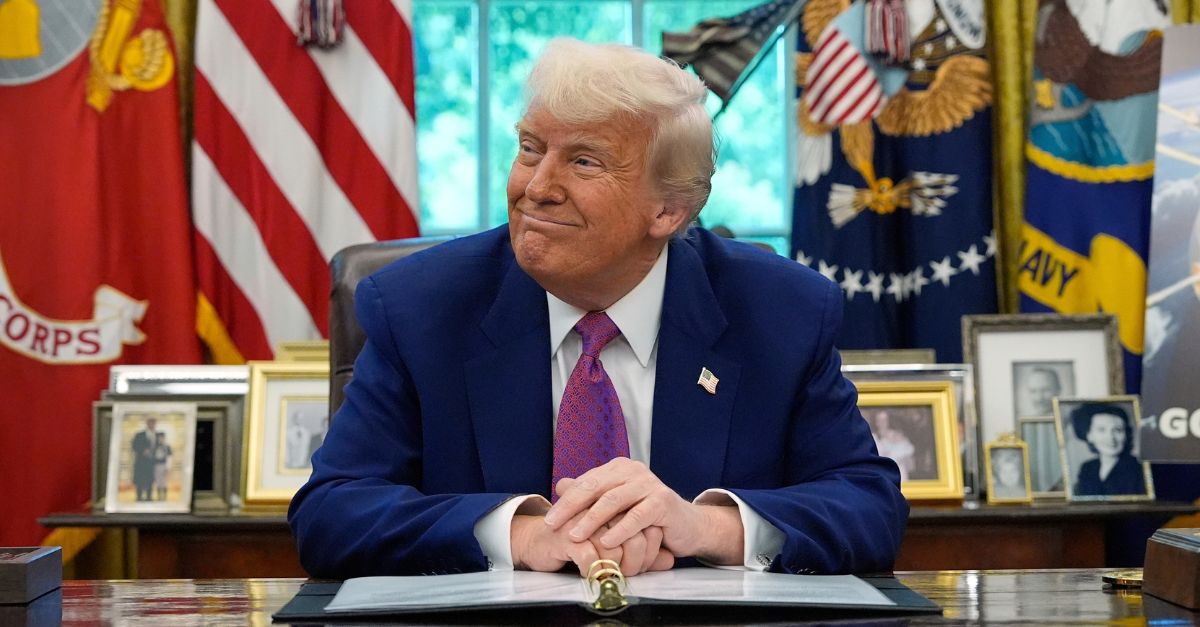
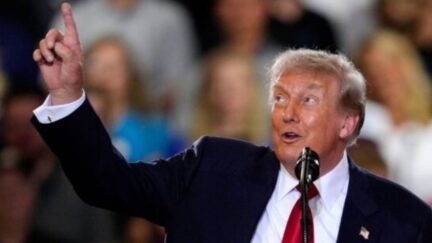
President Donald Trump smiles as he speaks in the Oval Office of the White House, Tuesday, May 20, 2025, in Washington (AP Photo/Alex Brandon).
The Trump administration "likely" used "generative artificial intelligence" — AI — to cite a nonexistent precedent in a recent immigration case brief, according to a federal judge in Michigan.
In the case, the petitioner, Izzeddin Ahmed Abdulghaffar Daghra, was detained by Immigration and Customs Enforcement (ICE) and filed a petition for a writ of habeas corpus in May.
During the proceedings, the petitioner complained that the government had kept him detained several months past a statutory 90-day timeline after he was granted bond by an immigration judge.
In a series of orders last month, U.S. District Judge Hala Y. Jarbou, who was appointed by President Donald Trump, took the government to task for the way Daghra had been treated by immigration authorities.
In early June, the judge directed the DOJ to state "whether Petitioner has been released and, if not, on what basis he remains detained."
In late June, she noted that "Petitioner is still in custody but [the government] does not articulate any legal basis for Petitioner's continued detention" and demanded to know "why the Court should not grant Petitioner's habeas petition due to Respondents' failure to provide a legal basis for Petitioner's continued detention."
Ultimately, however, the DOJ was saved by the bell of procedure.
"While this lawsuit was pending, the automatic stay of Petitioner's bond order expired," the latest order reads. "The Government now represents that the bond order is back in effect and Petitioner will be released if he posts the $35,000 bond. Accordingly, the Court finds that the habeas petition is moot and dismisses it without prejudice."
In other words, the government belatedly granted the petitioner the bond that ICE had originally revoked. The original revocation started the 90-day clock, which ICE subsequently violated by keeping the petitioner detained past those 90 days.
Still, the case is now moot because "plaintiff has received all the relief he sought," the judge noted, quoting precedent.
But that's not all.
Jarbou's order goes on to note the AI issue.
"There is one additional issue in this case that the Court must address," the order reads.
The court then cites, at length, one of the DOJ's responses:
More recently, the Sixth Circuit has reiterated that § 1226(e) bars challenges that "ask the court to reweigh the evidence underlying a bond decision or second-guess the Immigration Judge's discretionary judgment." See Taylor v. Hott, 724 F. App'x 387, 392 (6th Cir. 2018) (district court lacked jurisdiction to review IJ's bond denial where petitioner challenged flight-risk determination)
As it turned out, that section of the government's response to the court's initial order to show cause caused some problems.
"The cited case, Taylor v. Hott, is not located at the identified page of the Federal Appendix. Indeed, page 387 is contained within a different opinion…which is about commercial arbitration, not immigration bond determinations," the order explains. "In its research, the Court was unable to identify a Sixth Circuit case with the caption Taylor v. Hott, or any federal case containing the quoted language. Thus, it seems this citation was likely produced by generative artificial intelligence."
The judge then cites more precedent noting that "[i]t is no secret that generative AI programs are known to 'hallucinate' nonexistent cases."
"It should be obvious that any attorney who uses AI must scrupulously review its work product to ensure that the cited cases exist and that the citations accurately and fairly represent the underlying case law," the order goes on. "The duty of candor towards this tribunal demands no less."
The order concludes with a thinly veiled warning.
"Although the Court will not presently impose sanctions for this conduct, it goes without saying that the Government must ensure its future filings with this Court do not include nonexistent case law," Jarbou writes.


Comments