
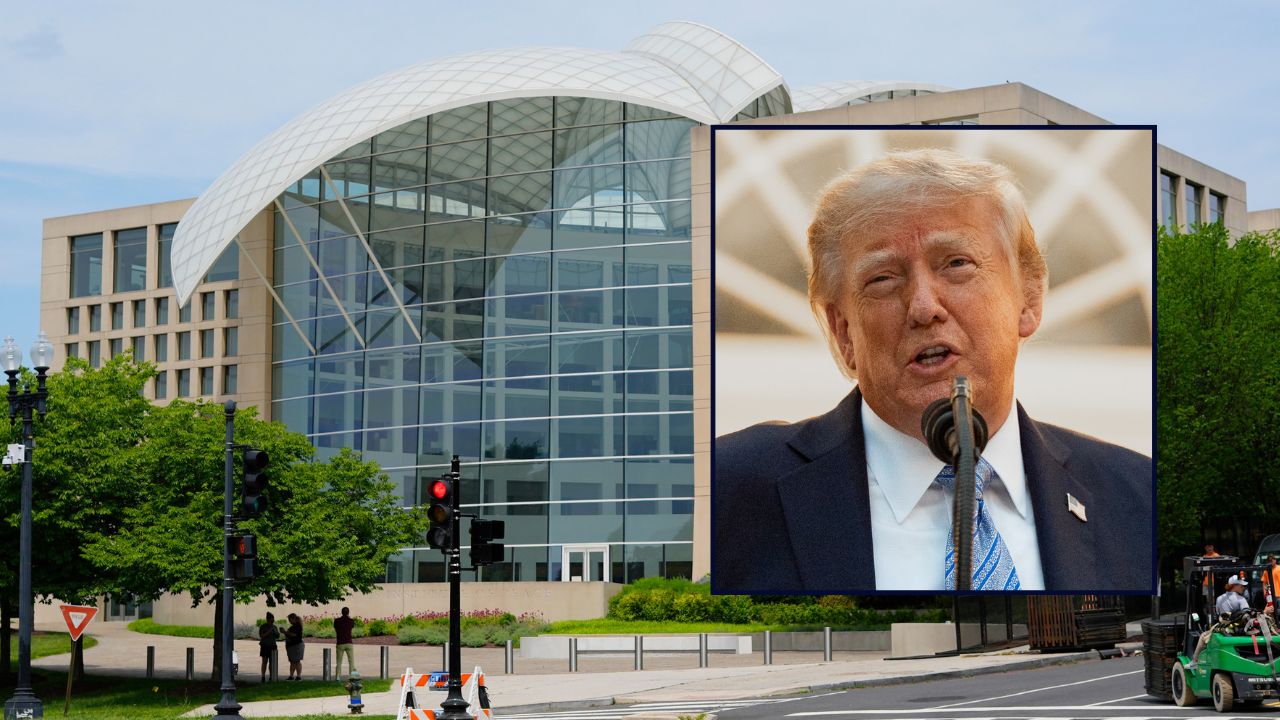
Inset: President Donald Trump speaks during a dinner in the Rose Garden of the White House, Thursday, Sept. 17, 2026, in Washington (AP Photo/Alex Brandon). Background: FILE – The headquarters for the U.S. Institute of Peace near the National Mall on June 10, 2025, in Washington (Pablo Martinez Monsivais, File).
President Donald Trump and his allies are trying to literally "carve" his name into the facade of the U.S. Institute of Peace (USIP) building, according to an emergency court filing by the independent agency.
Now, the institute wants a court of appeals to modify an earlier order "insofar as necessary to prohibit" the government "from carving" Trump's name into "any part of the USIP building or affixing his name on any other permanent USIP structure on the grounds."
The Thursday motion comes as the latest salvo in a long battle over the fate of the USIP and is something of a procedural oddity.
The institute itself, by way of its board members, is the plaintiff in the case — though those board members were fired in March 2025. Still, the USIP is considered the suing party and in May 2025, the axed board won at the district court level with a sweeping opinion penned by U.S. District Judge Beryl Howell, a Barack Obama appointee.
In late June 2025, however, a three-judge panel on the U.S. Court of Appeals for the D.C. Circuit revoked every aspect of Howell's order and injunction by issuing a stay pending appeal. Oral arguments for that appeal were originally scheduled for November 2025, but never happened. The merits of the case are nowhere close to being decided.
That's because, in September 2025, the D.C. Circuit, on its own initiative, held the appeal in abeyance pending the resolution of a case before the U.S. Supreme Court related to Trump's firing power. In June of this year, the high court ruled in Trump's favor, and the USIP moved to get the case back on track — a move opposed by the government.
Over the summer, the D.C. Circuit expressed some indecision, first denying a motion to reschedule oral arguments. Then, weeks later, it instructed the parties to file motions by Sept. 18 — and for oral arguments to be scheduled soon thereafter. Then the government asked for more time and received a two-week extension.
The institute says all this delay has amounted to dithering exploited by the Trump administration to the plaintiffs' detriment.
"The Court's sua sponte order holding the appeal in abeyance following the Supreme Court's grant of review in Trump v. Slaughter had the effect of nullifying the order expediting the government's appeal in light of the stay, and has now extended briefing for almost a full year beyond the end of the original briefing schedule," the emergency motion complains. "During that time, Appellants did not maintain the status quo as of the time of the District Court's order."
Instead, the government has moved forward with plans to remake the institute both organizationally and, concerning its headquarters designed to evoke the image of a dove in flight, physically "by affixing the President's name to the building," the plaintiffs say.
The filing elaborates on this point:
Having lost at the District Court, Appellants should not be able to take advantage of the Stay Order (and the unusually extended period it has been in effect) to literally set things in stone by stamping their view of the merits of this dispute into USIP's headquarters building.
But those efforts during the litigation hiatus have seemingly not been enough to satisfy the 45th and 47th president's designs.
"Unsatisfied with the relative impermanence of external lettering, Appellants apparently now intend to carve President Trump's name into the facade of USIP's privately owned headquarters building while this litigation is pending," the emergency motion states.
The institute notes the building "was largely funded by private donations to USIP as a tax exempt nonprofit." And, quoting a bit from Howell's ruling, the plaintiffs argue the "expressive architecture" was designed to be "symbolic of USIP's independent mission."
"Alteration of the design to impose a different message would cause irreparable harm," the motion goes on.
To that end, the plaintiffs asked the panel to slightly reconsider its own stay — by directing the parties to respect the status quo at the time Howell entered her injunction but only in relation to the physical USIP headquarters, inclusive of both the building and the grounds.
"Because circumstances have materially changed, and because Appellants are exploiting this Court's stay to threaten specific irreparable harm to USIP, Appellees seek a narrow modification of the stay to prevent Appellants from irreparably injuring USIP by carving President Trump's name into its headquarters building or any other permanent structure on the land under USIP control," the motion continues.
The institute says a presidential carving would be permanent, but the appeals court could easily stop before it happens.
"The threatened carving would impose serious irreparable harm," the motion argues. "It is a discrete act that can and should be forestalled through a limited, status-quo-preserving modification of the stay pending appeal."
Comments