
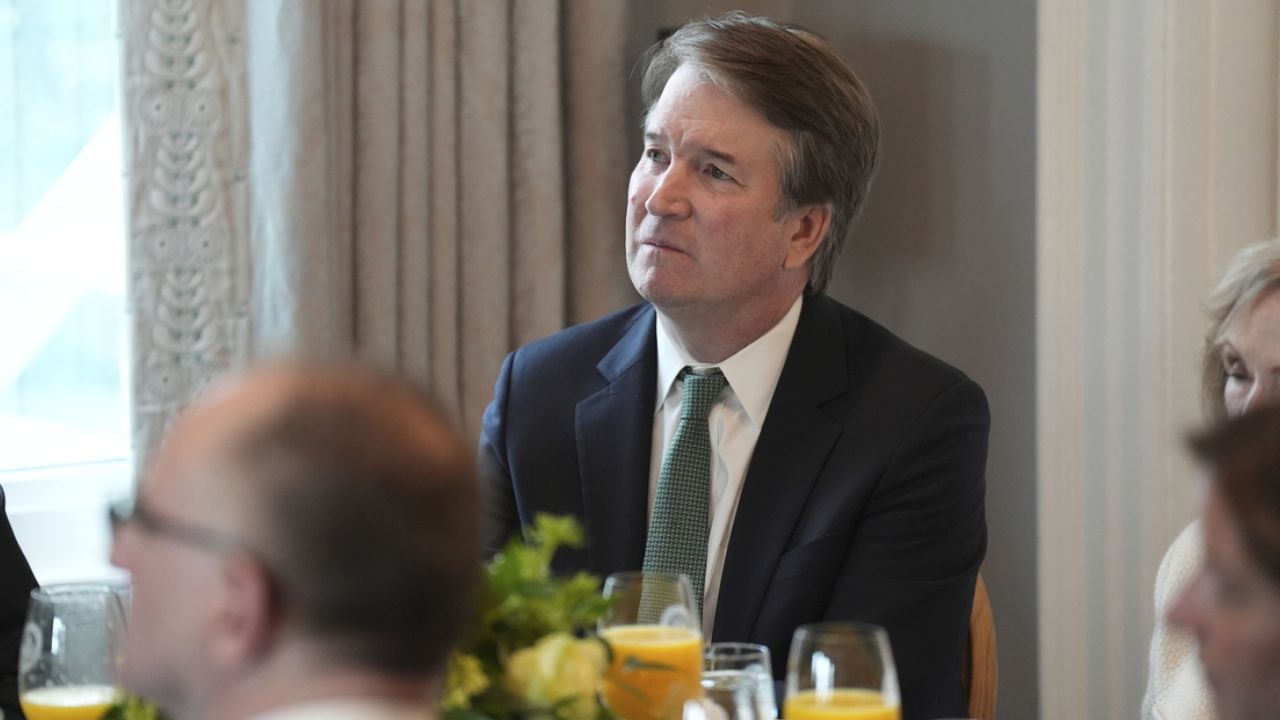
Associate Justice of the Supreme Court of the United States Brett Kavanaugh watches as Taoiseach Micheal Martin speaks at a breakfast meeting hosted by U.S. Vice President JD Vance at his official residence in Washington, D.C., as part of his week-long visit to the U.S. on March 12, 2025 (Press Association via AP Images).
A spate of filings landed on the docket of the U.S. Supreme Court on Wednesday afternoon as various parties sought to convince Justice Brett Kavanaugh and his colleagues to act — or not to act — on the fate of a "late-breaking" change to Missouri's congressional map.
While the dispute dates back over a year, motions practice has been decidedly feast or famine due to a series of important court decisions that seemed to settle the matter. But after several such resolutions, the case is once again before the nation's high court.
"It's deja vu all over again," one of six briefs filed Wednesday begins.
In that brief, a group of "qualified Missouri voters" implores the justices to respect state law and allow them to vote in a "referendum before the proposed map is used to elect members of Congress."
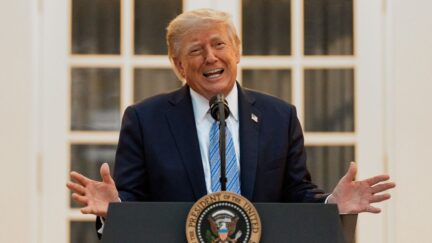
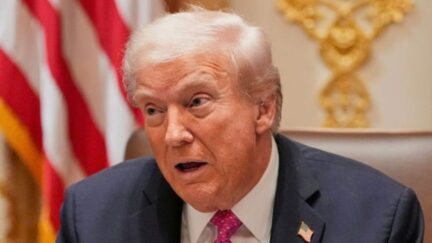
In August 2025, at the direction of President Donald Trump, Show-Me State legislators devised a pro-GOP gerrymander to be used in the upcoming midterm elections. Parallel litigation ensued in state and federal courts.
In May, the Missouri Supreme Court ruled on a challenge to the map that would give Republicans a 7-1 edge in representation. That case left some issues hanging in the balance depending on the validity of a referendum petition that wanted the map to go before voters.
But state officials went ahead with the gerrymandered map while the validity of the referendum was being litigated, holding a primary election in August under the new boundaries. In early September, however, in a second case, the Missouri Supreme Court determined the referendum should have been held — and invalidated the map.
Also in September, in a third case, GOP elected officials went to federal court in an effort to invalidate the Missouri Supreme Court's ruling. That effort resulted in the gerrymandered map being restored by Chief U.S. District Judge Stephen Clark, a Trump appointee.
Since then, the U.S. Supreme Court stepped in to revert to the pre-gerrymander map. On the same day, the Missouri Supreme Court held a contempt hearing with the Missouri secretary of state in its sights for defying court orders and to repeatedly insist that the gerrymandered map "is not the law and has never been the law."
What seemed to be a final statement on the matter was rendered all but moot on Monday when the U.S. Court of Appeals for the 8th Circuit issued a ruling that restored the gerrymandered map.
On Tuesday, the pro-referendum parties who were victorious before the Missouri Supreme Court asked Kavanaugh to step in again with an emergency application for a stay that would revert to the 2022 map. Invoking the Purcell principle of not causing chaos or confusion close to Election Day, the stay request notes that ballots have already been printed, distributed and cast under the pre-gerrymandered map.
Acting quickly, Kavanaugh directed all interested parties to file their shadow docket responses by 2 p.m. on Wednesday.
That call was answered — and then some.
In an amicus brief, another group of voters complained that 79 of them "were required to vote in a different district during the August 2026 primary election under a map that was never supposed to be in effect."
Of course, the high court was actually most interested in hearing from the named defendants in the case.
First of those defendants to file was Rep. Bob Onder, whose federal lawsuit set the showdown between state and federal courts in motion. In his response, Onder said the older map "violates the Constitution" and questioned the standing of one of the plaintiffs.
"Nothing has changed since September 10 except that Applicants have lost before the very court whose interlocutory posture justified this Court's first, temporary pause," Onder argued. "The application should be denied."
The GOP congressman invoked the Purcell principle as an argument against the U.S. Supreme Court taking action.
"A stay would not preserve the status quo," Onder went on. "It would be the very 'late-breaking' judicial disruption that Purcell — and Justice Kavanaugh's own opinions applying it — warn against."
Second of the defendants to file was Missouri Secretary of State Denny Hoskins, who earlier instructed local election officials to use the gerrymandered map and put himself in danger of contempt. Later, the state's highest court found that Hoskins "was" in contempt, which he quickly cured by reversing his earlier directive.
Hoskins also opposed the stay, but threw up his hands — and used both of them to pledge allegiance to the court.
"Regardless of whether this Court grants a stay or leaves the Eighth Circuit's injunction in place, Missouri and its Secretary of State (collectively, 'the State') will do whatever they can to help local election officials comply," the response reads. "Yet the honest truth is that—regardless of what this Court does—Missouri will not be able to run an orderly 2026 General Election."

Comments