

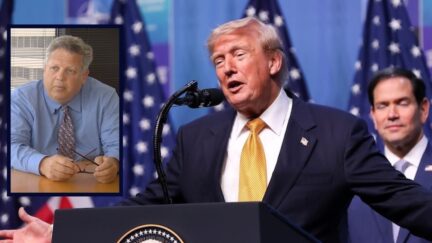
Left inset: Left: Chief U.S. District Judge James Boasberg (U.S. District Courts). Main: President Donald Trump listens as Homeland Security Secretary Kristi Noem speaks during a tour of "Alligator Alcatraz," a new migrant detention facility at Dade-Collier Training and Transition facility, Tuesday, July 1, 2025, in Ochopee, Fla. (AP Photo/Evan Vucci).
The Trump administration on Tuesday secured a key victory in a long-running spat with a district court judge who has earned the lion's share of the president's judicially focused ire over the past year or so.
In fact, the mandamus ruling issued by the U.S. Court of Appeals for the District of Columbia Circuit comes nearly one year to the day after the lower court order that arguably set the current controversy in motion.
On April 16, 2025, U.S. District Judge James Boasberg, a jurist who got his start under George W. Bush and who was later promoted by Barack Obama, found probable cause that the government was in contempt. That contempt finding was in response to the admitted violation of a March 2025 court order directing the Trump administration to turn two planes around containing 238 Venezuelan immigrants who were bound for a notorious prison in El Salvador under the auspices of the Alien Enemies Act (AEA) of 1798.
Two days shy of the one-year anniversary of that contempt finding, however, the appellate court has put a kibosh on the process.
In a 2-1 ruling, U.S. Circuit Judges Neomi Rao and Justin Walker, both of whom were appointed by President Donald Trump, voted to grant a petition of mandamus requested by the U.S. Department of Justice. In the minority was Circuit Judge J. Michelle Childs, an Obama appointee.
Issuing a writ of mandamus — a demand issued by a court for another court, or for a government agency, to do something specific — is rare. But this is not the first time the court of appeals has intervened in favor of the 45th and 47th president in the contempt battle.
In August 2025, Boasberg's first contempt order in the case was settled by way of a different three-judge panel via mandamus relief. Undeterred, the judge and the plaintiffs in the underlying case have been intent on getting to the bottom of the controversy to find out who, exactly, was responsible for violating his order in the first place.
Later, a fired DOJ whistleblower — and revelations associated with that case — led to the revamped contempt proceedings. In response to knock-on court filings, a "cursory" November 2025 government filing raised more questions and prompted Boasberg to push for more details with contempt hanging like a sword of Damocles.
In mid-December 2025, days after the mandamus petition was filed, the present three-judge panel issued an administrative stay of a then-days-old order setting hearings to determine whether a criminal contempt prosecution referral was warranted against then-Department of Homeland Security (DHS) Secretary Kristi Noem.
The appeals court describes the current state of affairs:
[T]he district court is proceeding with criminal contempt for the government's decision to transfer the plaintiffs to the custody of El Salvador. To cooperate, the government identified then-Secretary of Homeland Security Kristi Noem as the official responsible for the transfer decision. The district court previously said this was the only information it required to make a referral for prosecution. But the district court has now expanded its inquest and ordered hearings to extract more information from government counsel about exactly what happened last March.
But now, those hearings are not in the offing.
To hear the panel majority tell it, Boasberg is quite simply sticking his nose into places of executive branch reach. And such places, the court says, are not where a district court judge's nose belongs.
"The widening gyre of the district court's investigation again calls for the extraordinary remedy of mandamus to halt the judicial 'impairment of another branch in the performance of its constitutional duties,'" the opinion reads. "The district court proposes to probe high-level Executive Branch deliberations about matters of national security and diplomacy. These proceedings are a clear abuse of discretion."
The opinion goes on to chide Boasberg for subtle distinctions.
The district court judge's initial order – which was filed all but contemporaneously with the original lawsuit challenging the AEA determination as the planes were gearing up to leave – largely had to do with stopping the deportations. And, of course, much hubbub and consternation resulted from the judge initially ruling from the bench before the order was issued on paper.
The since-frustrated contempt battle, however, centered on the transfer of detainees into the custody of Salvadoran authorities.
Rao finds more than enough daylight between these issues.
"[T]he district court's order said nothing about transferring custody of the plaintiffs and therefore lacks the clarity to support criminal contempt based on the transfer of custody," the opinion goes on.
The panel also seems to think the relevant inquiry here is complete.
"The government has attested that Secretary Noem was the responsible official," the opinion continues. "Mandamus is appropriate again to forestall unwarranted judicial intrusion into Executive Branch decisionmaking regarding matters of national security."
The majority then characterizes Boasberg's ongoing contempt inquiry as an "unnecessary investigation," an "improper request," undergirded by an "antagonistic jurisdiction" that only mandamus can cure.
Rao says that under such circumstances the Trump administration has "a clear and indisputable right to termination of this judicial investigation because it is premised on an order that is insufficiently clear and specific to sustain a charge of criminal contempt."
In a concurrence, Walker, sometimes considered a protege of U.S. Supreme Court Justice Brett Kavanaugh, empathizes with Boasberg's position and praises his judicial acumen.
From the opinion, at length:
The district court needed to make a quick decision. The facts on the ground were changing, jurisdiction was unclear, and the merits depended on the meaning of a statute from the 1700s that hadn't been invoked in the past 75 years. I do not envy the position of any judge facing such time pressure to make hard and high-stakes legal decisions. Fortunately, the trial judge assigned to this case had more than two decades of judicial experience, with a widely respected record of dispassionate decisionmaking.
Still, among other reasons, Walker sided with the majority due to the contretemps over Boasberg's oral bench ruling and the eventual written order issued in the case. To that end, the concurrence attempts to cabin the opinion as one without much reach or relevance in terms of precedent.
"Why do I say that is irrelevant?" the concurrence asks and answers: "Because they had already been removed when the written order was issued. Which means the written order didn't cover them. Which in turn means their transfer to Salvadoran custody didn't violate the written order (which, again, had superseded the oral order)."
Matt Naham contributed to this report.





Comments