
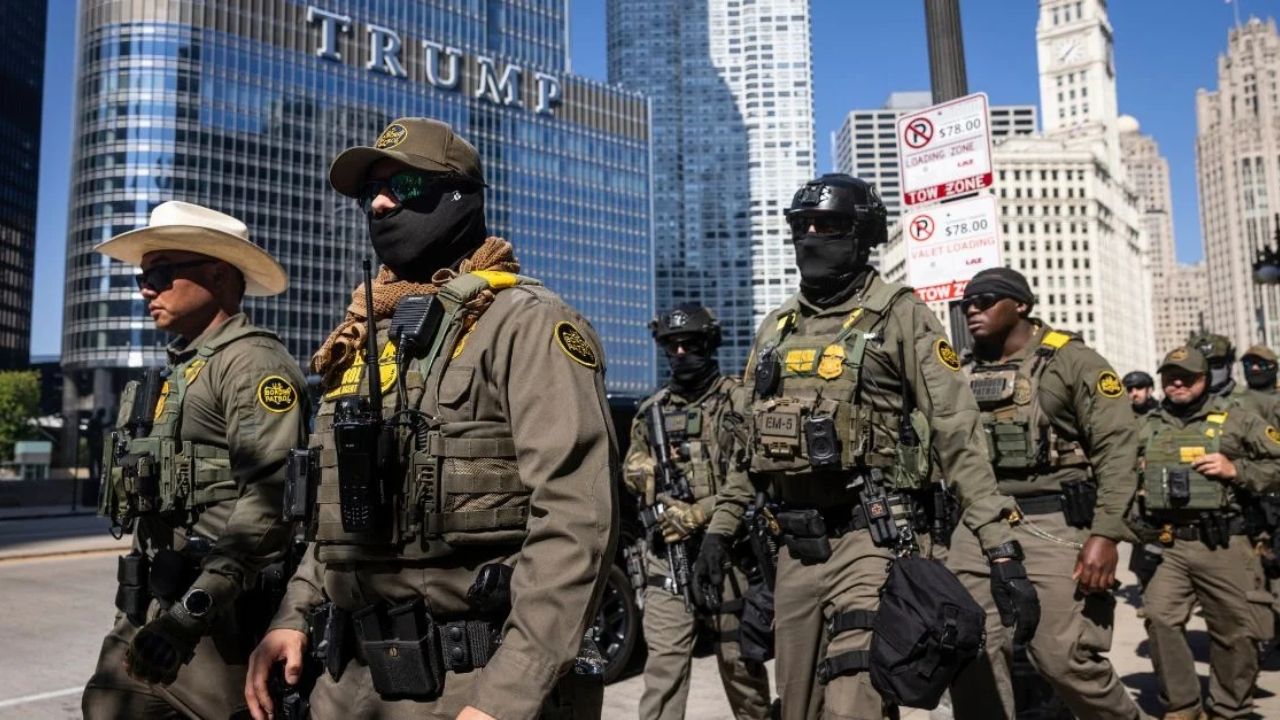
Federal agents from U.S. Immigration and Customs Enforcement and U.S. Customs and Border Protection walk along West Wacker Drive in the Loop, Sunday, Sept. 28, 2025, in Chicago. (Ashlee Rezin/Chicago Sun-Times via AP).
A federal judge in Oregon says he can no longer assume ICE agents are telling the truth in their arrest paperwork, declaring Monday that live testimony is now "necessary" after finding that warrantless arrests are still being made and facts are being "fabricated in official records" by immigration officers.
In a 50-page opinion, U.S. District Judge Mustafa Kasubhai ruled that ICE repeatedly violated an existing court order governing warrantless immigration arrests in the Beaver State, with inaccurate reports, missing records and accounts that did not match what actually happened.
The judge's loss of confidence in the agency was so pronounced that he withdrew the usual presumption that government officials have properly performed their duties.
"This presumption no longer holds for defendants," Kasubhai wrote. "Defendants are held to the same expectation as any other litigant before this court. One must earn credibility by acting with integrity."
According to Kasubhai, an ICE officer "fabricated facts in official records to justify an arrest." The judge, appointed by President Joe Biden, said the court knows this because at an evidentiary hearing on a motion to enforce a preliminary injunction barring warrantless arrests, the ICE officer "testified under oath" that what he wrote in the official records of the arrest "was incorrect."
On the witness stand, the officer tried to minimize the error "as mere oversight," according to Kasubhai.
"This court found he lied after evaluating his live testimony and the documentary evidence," the judge said in Monday's order. "Evaluating live testimony is a time-tested method for truth finding. Written declarations are convenient, but insufficient on their own when witnesses are willing to lie."
The ruling means ICE must now provide plaintiffs challenging its arrest practices with a much broader collection of records, including administrative arrest warrants, supporting evidence, documents given to detainees and body-camera footage from civil immigration arrests conducted since Sept. 1. The agency must also turn over previously disclosed material without redactions and repeat the court's instructions to relevant employees every 30 days.
The incident that helped convince Kasubhai that written arrest records could not be trusted without live testimony involved the ICE officer preparing a report claiming agents had recognized a passenger in a vehicle before stopping it and already had an arrest warrant for him. The officer admitted during a September evidentiary hearing that he had copied much of the narrative from a separate report about the driver and simply failed to change the details.
In reality, the officer said that he had not known the passenger was in the vehicle and did not even know who the man was when agents first stopped the car. He also acknowledged there was no warrant for the passenger at that point.
"[The ICE officer] was a sworn police officer for several years before becoming an ICE agent," Kasubhai explained. "On the stand he recounted the details necessary for obtaining search warrants and arrest warrants as well as the information needed for affidavits in criminal complaints. … This Court finds that he did not make a mistake … He lied in an official record to facilitate the impression he was conducting a lawful warrant-based arrest."
The incident demonstrates "intentional, coordinated falsification that would in all likelihood never have been uncovered but for this evidentiary hearing," according to Kasubhai. "Evidentiary hearings are essential tools to ensure that a rigorous record of something closer to the truth is preserved, and to hold liars to account," Kasubhai said.
The incident was not the only documentation problem the judge identified, according to his order.
In another report, ICE recorded an arrest as taking place near an address in Napa, California, when it actually happened in Hood River, Oregon. The agency also described a man's vehicle as a Toyota Camry when he was driving a Toyota Corolla — apparently confusing it with his brother's car, according to Kasubhai and the plaintiffs suing the government over the warrantless arrests, who are represented by the nonprofit firm Innovation Law Lab.
The government reported 13 warrantless arrests in Oregon over a six-month period, according to court records. After reviewing testimony and other evidence, Kasubhai concluded that the actual number was "significantly more than 13," per his order.
Kasubhai also found that agents had sometimes relied on immigration status itself to justify believing someone might flee, despite the court's requirement for an individualized assessment.
The court battle over the arrests began with an injunction issued Feb. 4, prohibiting ICE from making warrantless civil immigration arrests in Oregon without first determining that the person was likely to escape before officers could obtain a warrant. Kasubhai found that the agency continued making arrests without the required advance assessment and failed to provide the detailed records necessary to demonstrate compliance.
The Monday order makes clear that ICE's own classification of an arrest as warrant-based will no longer be enough to keep it outside the disclosure requirements.
"Defendants, through their own conduct, have lost trust," Kasubhai determined.
The judge emphasized that the consequences of misleading arrest records extend beyond litigation and paperwork. "Real people's lives and liberties are at stake and they should remember that," Kasubhai said, admonishing government lawyers involved in defending another challenged arrest.
The court's hearings are necessary, according to Kasubhai, because declarations and official reports cannot substitute for questioning the people who carried out the arrests — particularly when those accounts may be false, the judge said.
"The presumption of regularity directs the courts to assume, unless clear evidence indicates differently, that government officials have properly discharged their duties, acted in good faith and followed required procedures," Kasubhai concluded.
Comments