
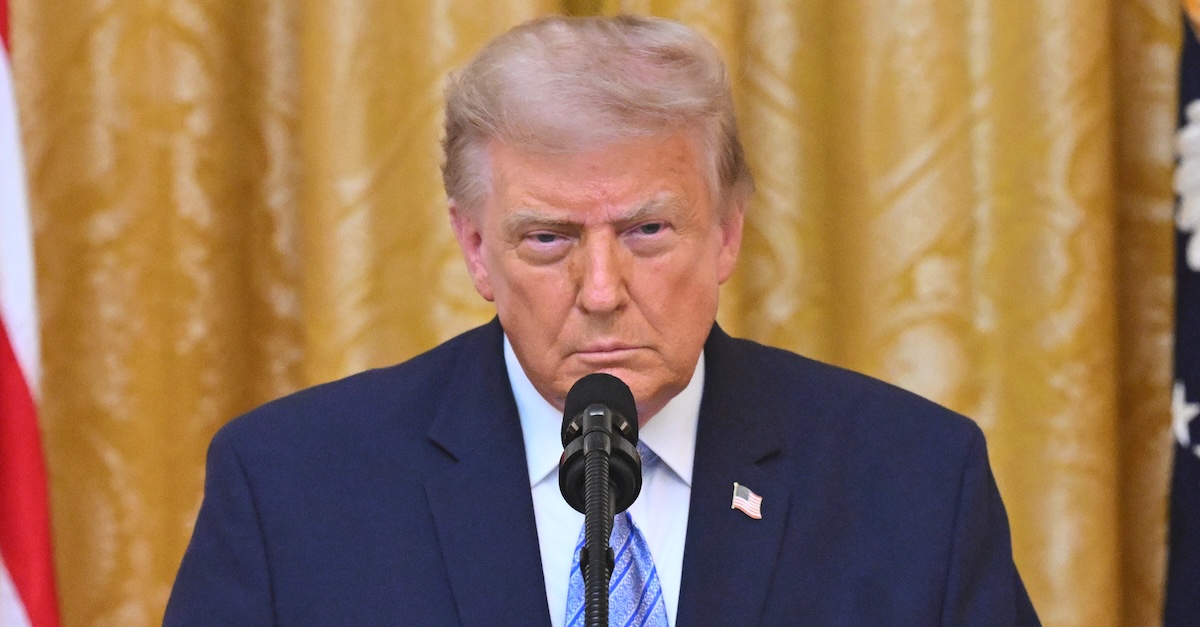
FILE – President Donald Trump speaks in the East Room of the White House, July 16, 2026, in Washington (Saul Loeb/Pool via AP, File).
A federal judge on Friday dismissed the Trump administration's lawsuit against a Michigan county that adamantly refused to cooperate with Immigration and Customs Enforcement (ICE).
On April 9, the U.S. Department of Justice filed a 53-page complaint against Washtenaw County, along with various officials and agencies, including the local sheriff's office. The lawsuit alleged the county had "become a sanctuary from the enforcement of federal immigration law and a harbor to removable criminal aliens."
"The challenged policies and actions…are invalid under the Supremacy Clause of the United States Constitution and therefore must not be permitted to further obstruct the efforts of federal immigration law enforcement to carry out its mission assigned by Congress," the original petition reads.
Now, U.S. District Judge F. Kay Behm, a Joe Biden appointee, has tossed the lawsuit for failure to state a claim in an 86-page opinion and order that grants the defendants' motion to dismiss in full.
"The Constitution imparts much authority on the federal government," the judge mused. "But neither the federal government nor the President may conscript local officials to enforce their will."
The court, in a lengthy analysis, views a great deal of the issues through the lens of the Immigration and Nationality Act (INA).
The judge notes the INA "contemplates the possibility of state and local cooperation with federal immigration officials, but it generally does not require cooperation with any particular federal request."
To that end, the court continues, localities that "disagree with the President's mass deportation scheme and have ended prior cooperation agreements with the federal government" have, as of late, largely left "federal immigration enforcement to federal officers and agencies – and have enacted policies to that end."
But the Trump administration insisted several Washtenaw policies enacted between 2021 and 2026 amounted to "obstruction of lawful federal immigration operations" and argued "local laws must yield."
The judge offered an uncharitable summary of ICE's perspective.
"Unwilling to take 'no' for an answer, the federal government now insists that the INA does not offer localities a choice at all," the opinion goes on. "Apparently flummoxed by the County's decision to focus its resources on local priorities and public safety, the United States sues to demand Washtenaw County's cooperation, the use of its jail cells, and its resources."
In one major point of dispute, the DOJ argued the defendants should be forced to comply with detainers issued by ICE agents.
The defendants expressly do not honor detainer requests unless they are accompanied with a valid judicial warrant signed by a judge.
"Forcing Defendants to honor detainer requests would require the County to use its limited 'law enforcement time, resources, and custodial facilities to arrest and hold individuals purely for federal civil immigration purposes,' — possibly in violation of the Fourth Amendment," the defendants argued.
The court, for its part, declined to rule on the Fourth Amendment issue because the detainer dispute was solved otherwise.
First Behm consults the anti-commandeering doctrine:
The government's preferred reading of the INA envisions that all local enforcement nationwide must track their detainees' immigration status (and any information that might conceivably have a future impact on that status), and then use their jail cells to hold those detainees pursuant to detainers authorized by the INA. But if local law enforcement were to in any way fail in their alleged duties to enforce federal law and promote the President's mass deportation scheme, the President lacks any authority to remove those persons, hire replacements, or control their actions in any meaningful sense…the government offers no way out.
In a dovetailing preemption analysis, the court also found that another disputed policy "does not purport to 'prohibit' or 'restrict' any state or local official from sending, maintaining, or exchanging information regarding the immigration status of any individual."
The court also found the local laws do not run afoul of the intergovernmental immunity doctrine — which bars state or local rules that regulate the federal government or discriminate against it.
"[T]hat ICE may use detainers consistent with the INA does not compel the conclusion that state or local officials must comply with those requests," the court goes on. "If the statute does not mandate compliance with the detainer, then the mere choice of a locality not to cooperate with detainer requests does not 'regulate' the federal government in any meaningful sense."
Since the court ruled on a motion to dismiss and in the defendants' favor in full, the opinion closes the case at the district court level.






Comments