
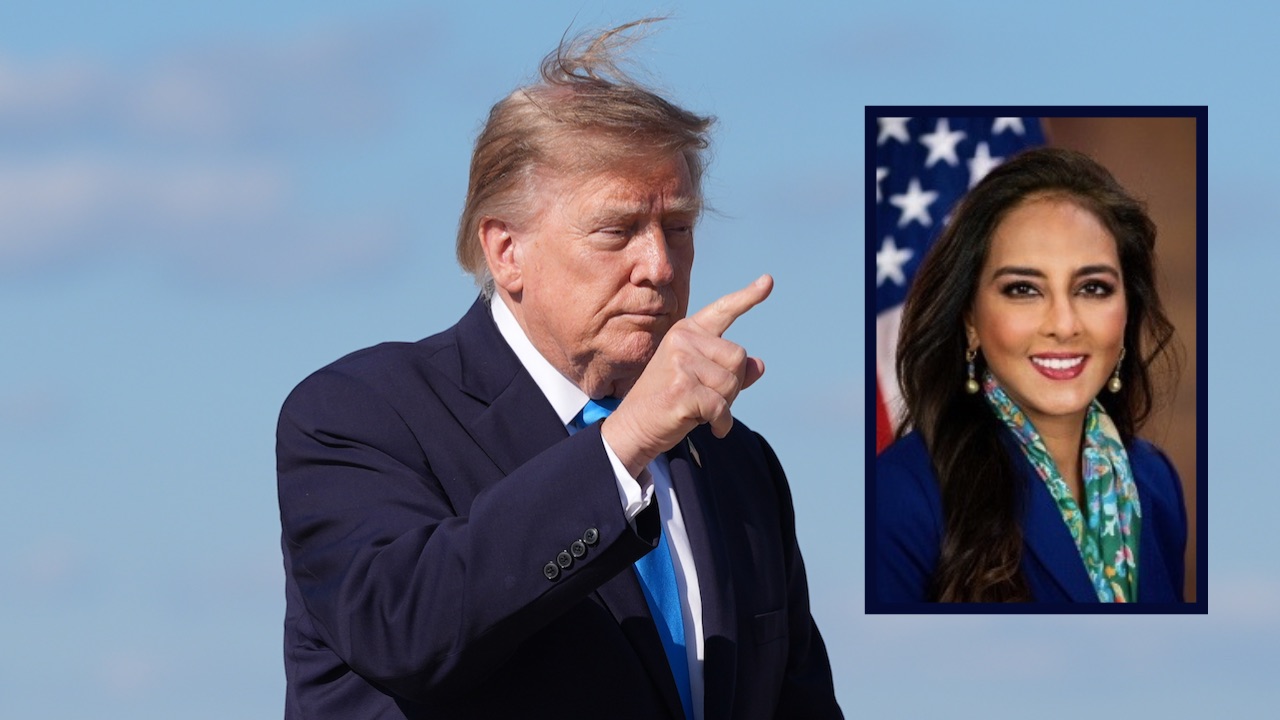
Main: President Donald Trump walks to board Air Force One, Monday, Oct. 5, 2026, at Joint Base Andrews, Md. (AP Photo/Alex Brandon). Inset: Assistant Attorney General Harmeet Dhillon of the DOJ Civil Rights Division (DOJ).
Days before Election Day, the U.S. Department of Justice (DOJ) has affirmed that it will not be sending any agents with the FBI or Immigration and Customs Enforcement (ICE) to polling places.
In a four-page declaration, Eric Neff, acting chief of the voting section of the DOJ's Civil Rights Division, wrote that with the exception of one U.S. Customs and Border Protection (CBP) employee, no Department of Homeland Security (DHS) workers will participate in the monitoring of polling locations across the country.
The Wednesday filing in the U.S. District Court for the District of Columbia came in the wake of a lawsuit filed by the NAACP, which warned of an "unprecedented deployment of federal officials" during the current election cycle, an action that "stands to jeopardize the election and interfere with the right of voters to participate in the election free from intimidation."
As Law&Crime previously reported, the NAACP filed that complaint on Oct. 2 against the DOJ's Civil Rights Division and its assistant attorney general, Harmeet Dhillon. The civil rights group argued there was an "urgent need" for the DOJ to share information about its plan to deploy "1,000 election monitors."
Dhillon defended the apparent surge in poll monitors, calling it "something that DOJ does."
Though U.S. District Judge Sparkle Sooknanan denied the NAACP's request for a temporary restraining order — which would have compelled the government to produce documents detailing the qualifications and roles of the monitors, the locations to which they would be sent, and other guidance — she asked the two parties to sit down and try to resolve the dispute.
Thus came Neff's declaration. He emphasized that his office is behaving "in a similar manner and for similar purposes as in past election cycles going back decades."
Though other federal law enforcement officers will be at polling sites, they will not be acting in a law enforcement capacity, Neff added. Rather, their job is mostly to observe and take notes on what they see.
The monitors may not carry firearms, they must wear business casual clothing without insignia showing their federal employment, and they may only talk with voters outside a polling location after they have cast their votes, Neff said.
Because the DOJ believes groups plan to "monitor" the monitors themselves, sharing the exact locations they plan to go to "would undermine" the DOJ's "monitoring effort and potentially put our monitors at risk," Neff continued.
The NAACP's lawsuit came as part of a larger effort to keep federal officers away from polling locations and avoid "intimidation" of prospective voters.
In California, a federal judge blocked the Trump administration from executing immigration enforcement-related field interrogations in locations containing U.S. citizens after voting rights groups sounded the alarm of lawful U.S. citizens being scared away from exercising their right to vote.
Election Day is on Tuesday.
Comments