
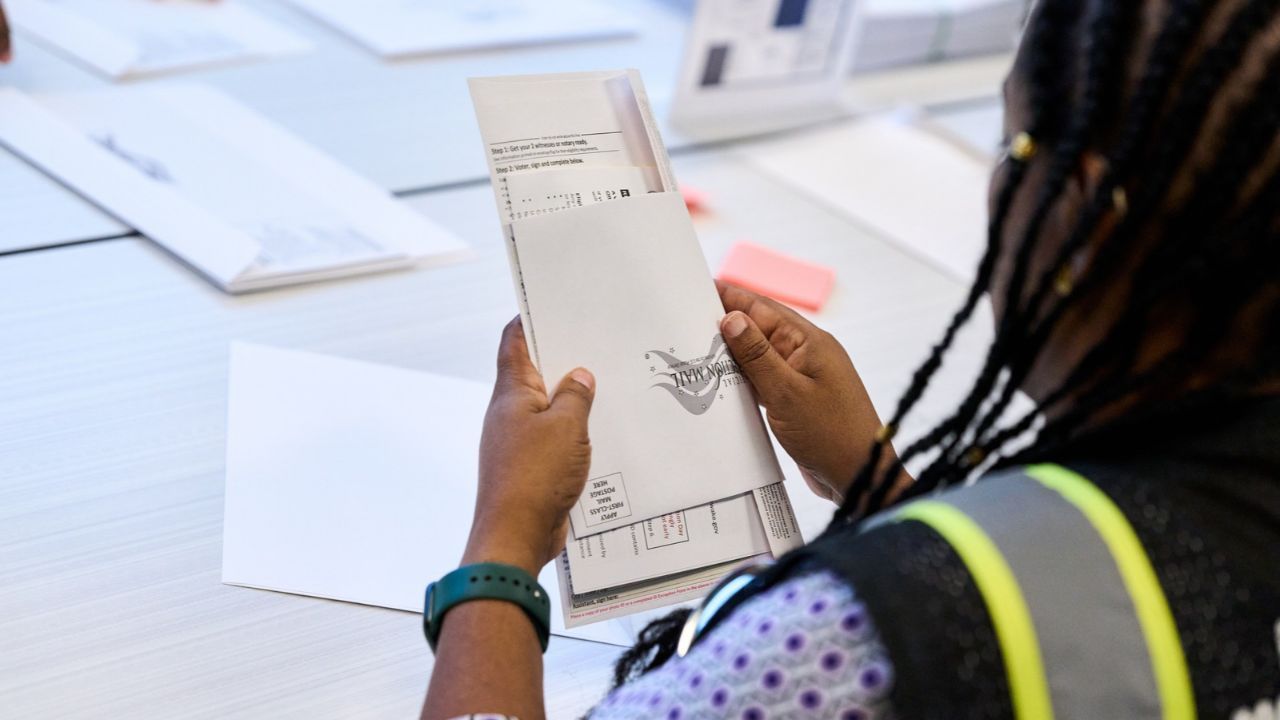
Wake County Board of Elections employees prepare absentee ballots to be mailed on Thursday, Sept. 3, 2026, in Raleigh, N.C. (AP Photo/Matt Ramey).
New restrictions to mail-in voting in North Carolina will remain through the midterm elections, a federal judge has ruled, as absentee voting is underway and Election Day is two weeks away.
In a 72-page order handed down on Monday, District Judge Thomas Schroeder declared that he would not make rule changes to an in-progress election and that voters have "ample opportunity" to cast a new ballot if the newly instated restrictions force their previous one to be tossed out.
Absentee voting is legal in North Carolina, a "swing state" often key in determining the result of federal elections. In February, however, the Republican-majority North Carolina State Board of Elections (NCSBE) ruled that preexisting instructions needed to be changed.
The changes — approved in August and incorporated on Sept. 4 — focused on two things: the so-called "Sealing Requirement" and the "Signature Verification Requirement," or collectively, the "Challenged Provisions."
The sealing requirement stipulated that a voter's absentee ballot be placed by itself in an inner envelope known as the "container-return envelope," and if that envelope was submitted unsealed without a note indicating the ballot was valid, it would be rendered illegitimate. The signature verification requirement demanded that county election boards ensure the signature on the absentee application matches the assigned voter.
On Sept. 22, groups such as the North Carolina Alliance for Retired Americans — a nonprofit voting rights organization — as well as individual registered voters, sued and then sought a preliminary injunction to stop the new changes. The North Carolina Republican Party and the Republican National Committee (RNC) joined the NCSBE as defendants, arguing that the recent restrictions were necessary.
Schroeder, a George W. Bush appointee, found that the facts and timing of the case favored the defendants.
The judge pointed to U.S. Supreme Court precedent holding that federal courts should not interfere with state elections "on the eve of" or during an election. "This alone merits denial of Plaintiffs' motion" for an injunction, he wrote.
Furthermore, Schroeder found that the voting rights groups and voters waited too long to bring their complaint — because even though the changes were implemented in September, they were voted on in April and adopted in July.
He also found no evidence that employees in certain counties would apply the rules differently than those in other counties.
Finally, even if a problem with a voter's absentee ballot was observed, "the voter still has many options to cast a vote" because they will be contacted and likely able to vote in person before or on Election Day.
Democracy Docket, an opponent of the new restrictions, called the judge's decision "a blow to voters."
The voting rights platforms pointed to two accounts from county election board members saying that more than 2% and 2.5%, respectively, of ballots received in the past three weeks were being rejected.
On Sept. 4, after the NCSBE's incorporation of the changes, Gov. Josh Stein, a Democrat, called the new restrictions "technicalities."
"The State Board's decision is a slap in the face to voters who stood up to these changes and a blatant circumvention of the law," he added. "North Carolina voters deserve transparency in their elections, not last-minute workarounds that could keep their vote from counting."


Comments