
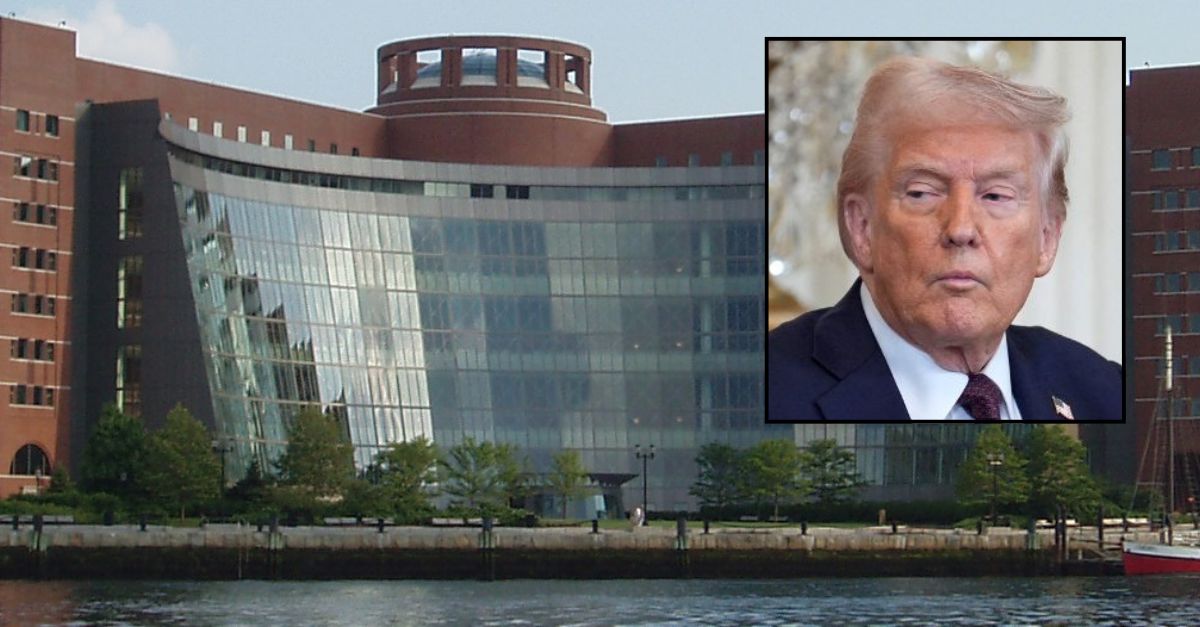
Background: The John J. Moakley Courthouse in Boston, Massachusetts, where the Boston-based 1st U.S. Circuit Court of Appeals meets (U.S. District Court for the District of Massachusetts). Inset: President Donald Trump at a press conference at the White House in Washington on February 27, 2025 (Yuri Gripas/Abaca/Sipa USA; via AP Images).
The Trump administration may not cut billions of dollars in funding that the National Institutes of Health (NIH) provides in research grants, a federal appeals court has affirmed.
To do so would be to contravene a provision set up by Congress and violate the Department of Health and Human Services' (HHS) own regulations stipulating that NIH reimburses "outside entities" based on "actual, documented research costs" rather than via "lump-sum awards," the 38-page order from the U.S. Court of Appeals for the 1st Circuit reads.
The case began when, on Feb. 7, 2025, NIH issued a "Supplemental Guidance" announcement stating it would begin capping its reimbursement of "indirect costs" associated with NIH-funded research starting the following business day. Three different plaintiff groups, made up of 22 state attorneys general, medical associations, and universities, promptly filed suit.
As the opinion helmed by Senior U.S. Circuit Judge Kermit Lipez lays out, recipients of NIH funding are eligible to receive reimbursement of two types of research costs: direct costs and indirect costs. While direct costs are "research costs attributable to a single research project," indirect costs are more complicated.
Also known as "facilities and administration" — or F&A — costs, they "cannot be 'readily and specifically' attributed to a single research project" and often consist of equipment improvements, utilities payments, and the salaries of administrative personnel. The Trump administration sought to place a cap on the reimbursement of these "indirect costs" at 15%, which, according to the ruling, amounted to a withholding of around $4 billion.
Boston-based U.S. District Judge Angel Kelley essentially said not so fast, issuing a preliminary injunction "barring NIH from taking any steps to implement, apply, or enforce the" new guidance. The preliminary injunction was converted to a permanent injunction, and the guidance was deemed invalid "in its entirety."
Though the Trump administration would appeal, landing the case before the U.S. Court of Appeals for the 1st Circuit, Lipez and the other two judges on the panel found the administration's arguments unavailing. For one reason, the judges noted, efforts by multiple presidential administrations to put limitations on reimbursements of indirect costs have, "with few exceptions," failed.
According to the opinion:
One such failed effort is particularly relevant here. In 2017, the first Trump administration issued a budget proposal for 2018 advocating a 10% cap on NIH's reimbursement of indirect costs. The proposal explained that reducing expenditures on indirect costs would allow "available funding [to] be better targeted toward supporting the highest priority research on diseases that affect human health" and would "bring NIH's reimbursement rate for indirect costs more in line with the reimbursement rate used by private foundations." Congress rejected that proposal, with the House Appropriations Committee explaining that it "would have a devastating impact on biomedical research across the country," and the Senate Appropriations Committee noting that it "would radically change the nature of the [f]ederal [g]overnment's relationship with the research community" and "jeopardiz[e] biomedical research nationwide."
Congress went even further and "enacted an appropriations rider 'directing NIH to continue reimbursing institutions for F&A costs' and prohibiting NIH from using appropriated funds 'to implement any further caps on F&A cost reimbursements,'" the opinion says. The Trump administration acknowledged in its 2019 budget proposal that it was indeed prohibited by law "'from reducing grantee administrative costs and shifting these resources to support direct research' and urged Congress to 'eliminate the current prohibition.'"
"Congress declined to do so and instead reenacted the appropriations rider. It has continued to do so in every subsequent year," the opinion adds, noting that in February 2025 the legislature announced that it would impose "a standard indirect rate of 15% across all NIH grants for indirect costs in lieu of a separately negotiated rate for indirect costs in every grant."
"Congress went to great lengths to ensure that NIH could not displace negotiated indirect cost reimbursement rates with a uniform rate," Lipez later wrote.
The opinion added that a sudden uniform cap on indirect costs would go against HHS' very own regulations that set forth how NIH grant recipients are awarded funding.
The judges held that "NIH's attempt, through its Supplemental Guidance, to impose a 15% indirect cost reimbursement rate violates the congressionally enacted appropriations rider and HHS's duly adopted regulations," Lipez finished by saying. "The district court's decision is therefore affirmed."




Comments