
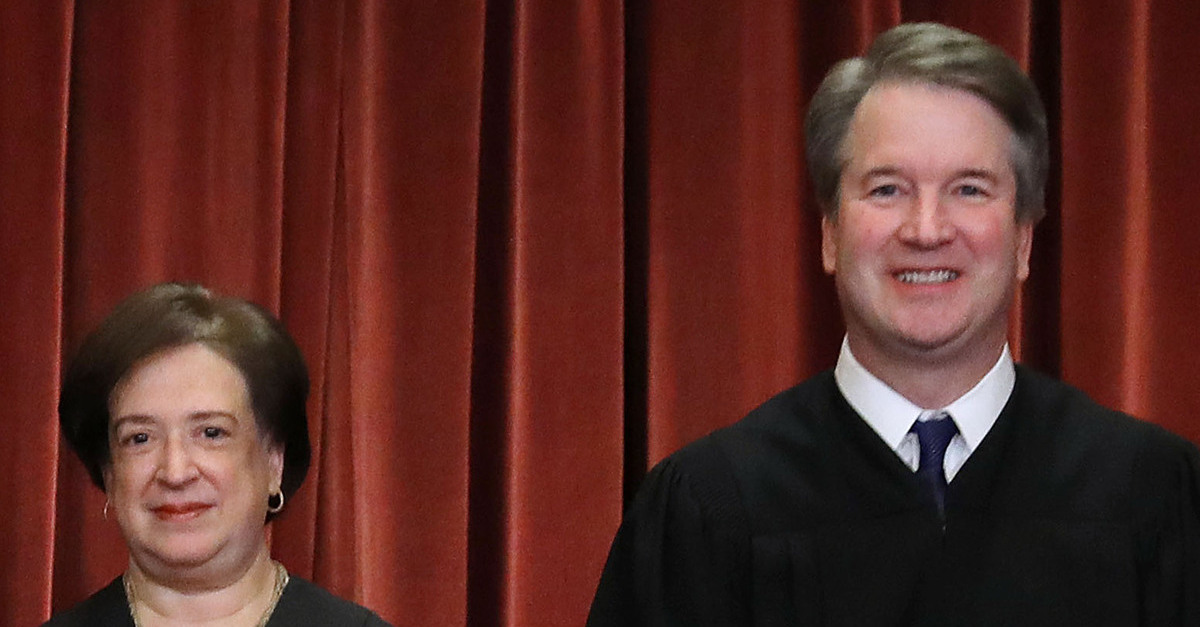
WASHINGTON, DC: Associate Justice Elena Kagan and Associate Justice Brett Kavanaugh pose for their official portrait in the East Conference Room at the Supreme Court building November 30, 2018, in Washington, DC. (Photo by Chip Somodevilla/Getty Images).
The U.S. Supreme Court on Tuesday paved the way for an avalanche of political party spending to be unleashed in the upcoming midterm elections and the broader political arena for years to come.
In a 6-3 decision, the court's Republican-appointed justices voted to jettison a section of the Federal Election Campaign Act (FECA) that limits coordinated spending between candidates and political parties.
The opinion by Justice Brett Kavanaugh overturns a 2001 Supreme Court case that maintained the expenditure limits. The decision shores up the legacy of the Roberts Court as particularly skeptical of legislative efforts to limit the flow of money in politics.
The majority casts rolling back spending constraints in politics as both natural and necessary. Kavanaugh argues that political parties, in particular, have been handicapped since rulings like Citizens United and the advent of super PACs and similar groups.
"To uphold the political-party coordinated-expenditure limits here could therefore help consign political parties to continued second-tier status as compared to outside groups," Kavanaugh's opinion reads. "Weakened political parties distort the political system."
The ruling is a victory for the GOP and the Trump administration. The original lawsuit was filed by Vice President JD Vance — when he was still a senator from Ohio — and the National Republican Senatorial Committee as a First Amendment violation. The U.S. Department of Justice ultimately backed the petition challenging the law.
Writing in dissent, Justice Elena Kagan took on the arguments of the intervening Democratic Party and sarcastically cast the decision as exceedingly unlikely to effect positive change in the political system, while far more likely to cause an increase in political corruption.
"I suspect it will not be difficult in a decade or two to disprove the majority's view that what has been standing in the way of a fully functional party system is [a prior 2001 ruling]," the dissent reads.
The dissent delves into some of the minutiae of campaign finance law to argue that the majority has essentially created an end run around individual contribution limits — while chiding the majority for an "unwillingness to deal in the specifics of campaign finance."
"The challenge for the majority is to explain how to prevent circumvention of the base contribution limits without the limits on a party's coordinated expenditures in place," Kagan writes.
This task, however, is not accomplished, according to the dissent. Instead, the dissent says, the majority "wends its way through no less than three strawman arguments." Here, Kagan outright accuses Kavanaugh of "stalling" for lack of a good argument.
"Once it gets to the crucial question, it has no satisfying account to offer," the dissent goes on. "The majority places all its hopes on two alternative 'prophylactic measures': earmarking rules and disclosure requirements. But those two measures alone are insufficient to the task. Without caps as well, they can be thought enough only when taken with generous doses of either willful blindness or wishful thinking."
Kagan creates a hypothetical "John Smith" candidate to engage in a series of examples seeking to dispel the majority's reasoning.
Here, the dissent notes there is still a $7,000 base limit for what one person can contribute to one candidate per cycle — this is an ever-changing limit subject to Federal Election Commission guidance.
Kagan says the newly created state of affairs could effectively nullify such limits due to how joint victory funds operate. Under such funds, a candidate coordinating with the national party and all 50 state parties can increase an individual donor's limits to in excess of $550,000.
Under Kavanaugh's preferred earmarking prophylactic, a donor would need to make clear that a $550,000 check is supposed to go to the candidate first — maxing out at $7,000 per cycle — and then the rest would flow down to the other entities that make up the joint aspect of the fund.
"But suppose the donor, with no such instruction, just sends a $550,000 check to the John Smith Victory Fund," Kagan asks.
The dissent goes on, at length:
That [$550,000] payment is, according to campaign finance law, all well and good: None of it counts as an earmark. So the mechanism I outlined above—the $550,000 is given to the Victory Fund, then gets disbursed to state party committees, then gets pooled in the national party committee, then is used to pay the candidate's bills—is entirely unaffected by earmarking rules. That means a donor, regardless of those rules, can pay $550,000 to support the candidate's campaign (despite the $7,000 base limit)—with all the opportunities for political corruption that such outsized donations raise.
Kagan dismisses the second Kavanaugh prophylactic in short order.
"It is good that voters can learn of the size of contributions," the dissent continues. "But that information does not reveal quid pro quo dealing, and so cannot adequately deter it…To count on disclosure to prevent corruption is as much as to give up on the goal itself."
Comments