
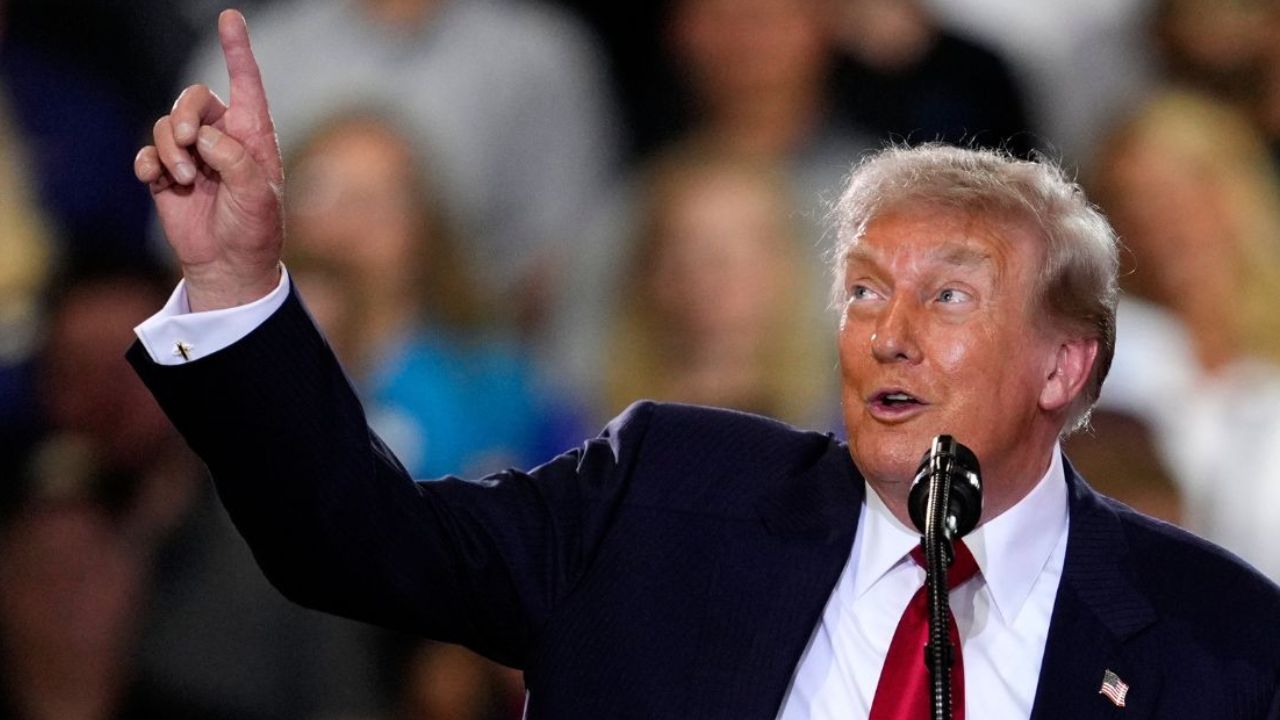
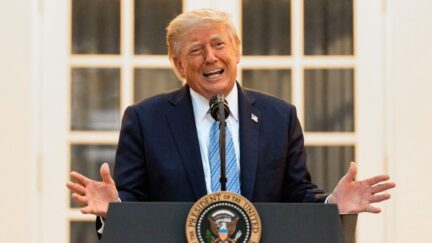
President Donald Trump speaks at an event at the General Motors Proving Ground Monday, July 27, 2026, in Milford, Mich. (AP Photo/Paul Sancya).
The Trump administration asked for and received the dissolution of an injunction that previously barred the government from acting on an executive order exerting federal authority over mail-in voting.
On Wednesday, in a nine-page memorandum and order, U.S. District Judge Indira Talwani, a Barack Obama appointee, ruled relatively quickly — though decidedly not as quickly as the government wanted.
On Monday night, the Trump administration filed an emergency motion to reconsider the injunction — which had been in place since Aug. 11 — demanding a ruling from Talwani by 5:30 p.m. on Tuesday.
In the meantime, however, the court addressed an earlier filing from the plaintiffs about the government's compliance with the injunction.
Over the weekend, the government told Talwani that it had issued a final rule — and published it on the Federal Register. The rule purports to give the U.S. Postal Service (USPS) control over several aspects of mail-in voting and would punish noncompliant states.
The plaintiffs in the case, the League of Women Voters, quickly protested, telling the judge the USPS had "flouted" the court's order "by sending for publication a final rule with immediate effect" that violated the injunction, as Law&Crime previously reported.
On Tuesday night, Talwani agreed with the plaintiffs.
The Tuesday night ruling was something of a wash for both parties. Talwani found the Trump administration in violation of the injunction but declined to issue any remedy "other than identifying the violation." At the same time, the judge offered the plaintiffs a road map for further litigation — based on the fact of the USPS issuing its final rule and therefore rendering its arguments "no longer hypothetical."
But the chaotic state of the litigation was not limited to the government's rulemaking in violation of the injunction.
Also on Monday, the U.S. Supreme Court stayed a substantially similar injunction issued by Talwani in a separate but related case — one brought by several states challenging Trump's USPS order.
This shadow docket ruling was not a merits decision and conceded that it "does not mean that any measure taken by the Government to implement the Order will necessarily be lawful."
In essence, the nation's high court gave the government a chance to try to implement the executive order while appeals play out.
In its late Monday order requesting reconsideration, the government came armed with the shadow docket ruling in Talwani's other case, arguing that "the Supreme Court has repeatedly instructed that district courts must follow its interim orders in similar cases."
On Wednesday, the judge agreed with the Trump administration.
"[T]his court is compelled by the Supreme Court's ruling to grant Defendants' Motion to Reconsider and vacate the preliminary injunction obtained by the Plaintiff Organizations," Talwani wrote.
For the second time in two days, the judge pointed out that the justices had nothing to say about the government violating the injunction.
"The Supreme Court accepted the government's feigned compliance," Talwani observed in a footnote to her Tuesday order.
In the Wednesday order, she wrote: "The [Supreme] Court's order made no reference to the USPS's publication of the final rule that prior Friday night." In another footnote, she noted that the high court issued relief to the government because the other injunction "prevents the Postal Service from so much as initiating a rulemaking."
The government, of course, did exactly that — by ignoring the injunction, the judge pointed out.
The judge then went on to review the differences between the earlier state-initiated case and the case brought by the League of Women Voters — largely focusing on the nature of the plaintiffs' claimed injuries.
"The court finds it likely that the Supreme Court would apply the same reasoning here, despite the different injury," Talwani observed.
The judge also reiterated the admonishment she received from the conservative majority: "Federal courts review final rules, not proposed rules — and certainly not antecedent internal directives to propose a rule."
Then, Talwani criticized the high court again:
Plaintiffs note that the "final rule" to which the Supreme Court referred was published by the USPS late Friday night, on August 21, 2026. And that late publication answers in the affirmative the question of "whether the agency would issue a final rule." But even this promulgation may not be good enough, for regardless of what chaos may be unleashed as litigation is pending, by declining to differentiate ripeness and standing, the Supreme Court appears to be implying that ripeness must also be measured when the suit is filed.
"In sum, the court finds that, in light of the Supreme Court's decision in Trump v. California, Plaintiff Organizations are not likely to prevail as to ripeness without amending their complaint to reflect the fact that a Final Rule has now issued," the court's order concludes.
The plaintiffs filed an amended lawsuit reflecting the final rule within minutes of Talwani's order being released.
"That uncertainty is gone," the 31-page supplemental complaint reads.

Comments