

Image provided by Wyatt Law Firm.
Federal rules cap most property-carrying drivers at 11 driving hours after 10 straight hours off duty. Exceptions, enforcement practices, and hours-of-service violation penalties in 2026 shape what an hour-12 case becomes.
A trucker's electronic log rolls from 10:59 to 11:00 while the rig is still moving on the interstate. If it keeps rolling past 11:00, a potential federal hours-of-service violation arises. The clock alone settles nothing.
A property-carrying driver who starts a 12th hour of actual driving generally violates the federal 11-hour limit unless a valid exception applies. The driver can be placed out of service, and hours-of-service penalties can reach the motor carrier too. A violation, on its own, proves nothing about fatigue or fault in a crash.
Federal civil penalty ceilings are adjusted for inflation each year, so the September 2026 figures will not match older enforcement summaries. Any penalty analysis should use the amount in effect when the violation is assessed.
Is Hour 12 Automatically an Hours-of-Service Violation?
Sometimes, but not on its own. If "hour 12" means a 12th hour of actual driving after 10 straight hours off duty, the driver ordinarily may not keep driving unless a valid exception changes the limit. If it means the 12th hour since coming on duty, driving can still be lawful, provided the driver has driving time left and stays inside the 14-hour window.
When it comes to truck hours of service violation penalties, two clocks run at once, and they measure different things under 49 C.F.R. § 395.3.
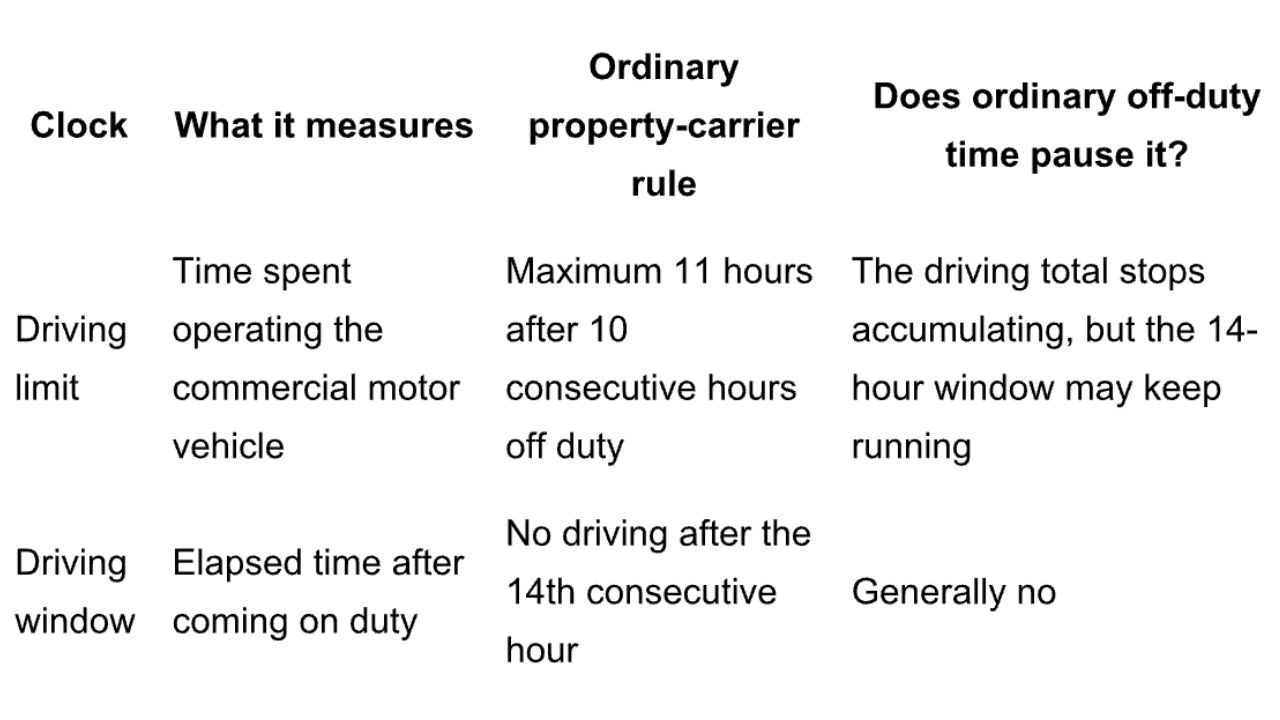
Consider one shift:
- The driver comes on duty at 6 a.m.
- One hour is spent on a pre-trip inspection and loading, logged as on-duty nondriving time.
- Ten hours follow behind the wheel, with qualifying nondriving breaks taken as needed.
- At hour 12 of the shift, the log shows only 10 driving hours, so an 11th hour may still be available inside the window.
- A driver who has already logged 11 driving hours and stays behind the wheel violates the rules unless an exception applies.
What are common hours-of-service violations?
Citations most often target the 11-hour driving limit and the 14-hour window. Inspectors flag skipped 30-minute interruptions after eight cumulative driving hours, blown 60- and 70-hour limits, and duty-status records that do not match the trip.
Which Exceptions Could Make Additional Driving Lawful?
The adverse-driving-conditions provision in 49 C.F.R. § 395.1(b)(1) can matter during a 12th driving hour. The short-haul provision in § 395.1(e)(1) does not raise the 11-hour ceiling.
When does the adverse-driving-conditions exception apply?
The conditions must be unforeseen. Under § 395.2, they cannot have been reasonably known to the driver immediately before the duty day began, or to the carrier before dispatch. Unexpected snow, dense fog, a sudden road closure, or an unannounced shutdown may qualify, given the facts.
When it applies, the exception permits up to two extra driving hours and stretches the driving window by up to two hours. It excuses nothing else. A driver who is fatigued, ill, or otherwise unsafe may not continue.
An interstate that closes after dispatch can qualify. Routine congestion does not become an adverse condition just because a delivery is late.

Image provided by Wyatt Law Firm.
Does the short-haul exception allow a 12th driving hour?
No. A qualifying short-haul driver operating within a 150-air-mile radius, returning to the reporting location within 14 hours, may use time records in place of a standard record of duty status. The 11-hour maximum still applies. The exception loosens recordkeeping, not driving limits.
Truck hours-of-service violation penalties range from out-of-service orders to inflation-adjusted federal maximums. What ties any of it to a crash is fatigue evidence, and a violation must still connect to the collision before it supports a conclusion about causation or liability.
What Happens After an HOS Violation?
An inspector documents the violation, reviews the driver's records, and places the driver out of service when enforcement criteria call for it. The FMCSA or a state partner may later pursue a civil penalty, and the carrier may face separate compliance scrutiny.
What evidence can an officer examine?
The data trail extends past the log screen. An officer may compare electronic logging device records and required annotations with the record of duty status maintained under § 395.8. Supporting documents include bills of lading, fuel receipts, toll records, dispatch messages, and telematics data.
Discrepancies among those records can matter more than any single entry. When a driver claims an exception, investigators check whether the qualifying conditions existed and were documented at the time. Records must be kept for the periods federal regulations specify; a retention failure creates its own compliance problem.
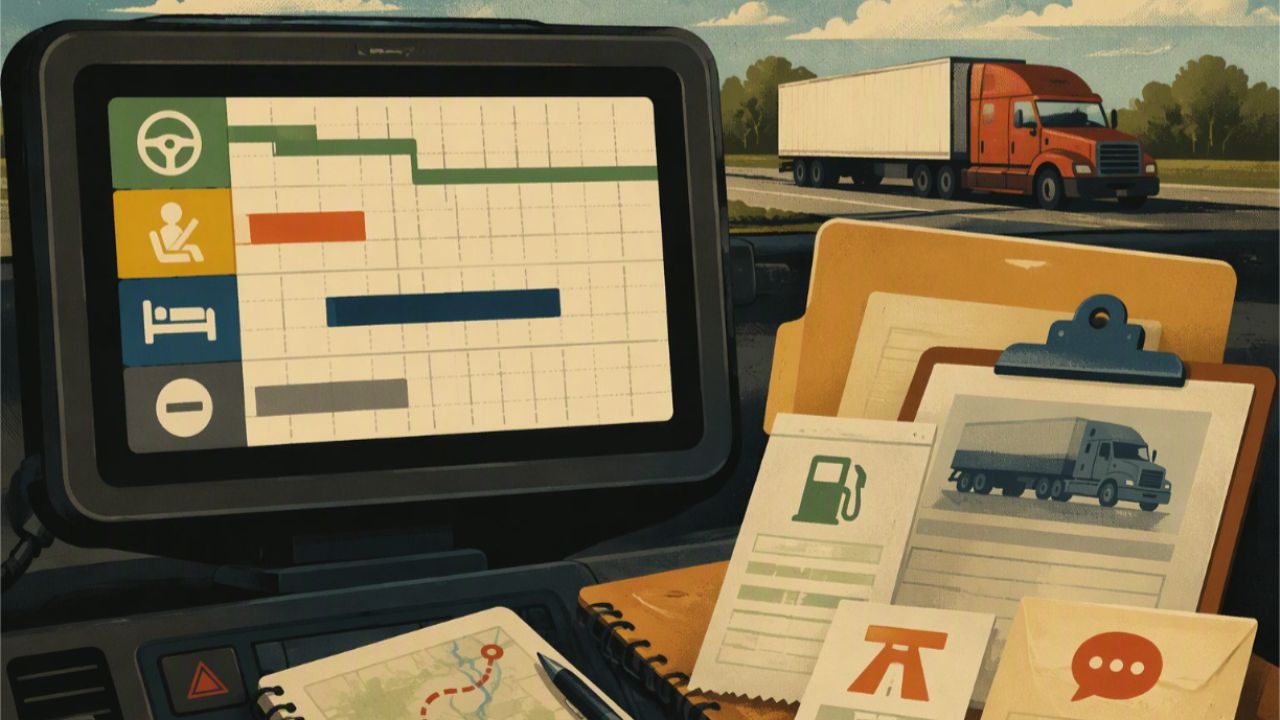
Image provided by Wyatt Law Firm.
How Are Hours of Service Violation Penalties Determined in 2026?
Federal law sets maximum civil penalties for truck hours-of-service violations, false records, and violations of out-of-service orders. Those ceilings are inflation-adjusted, so the applicable 2026 amount hinges on the provision charged and the adjustment in force when the penalty is assessed.
There is no single hours-of-service violation fine amount. A maximum is not automatically applied. The actual amount reflects the violation, the facts, the enforcement authority, and the carrier's or driver's conduct, within what the law permits.
What are the HOS violation consequences for drivers?
Consequences can include an out-of-service order that halts the trip, civil penalty exposure, a documented inspection violation, employer discipline, and closer compliance review. Those administrative consequences are separate from criminal proceedings and state license sanctions, which follow their own legal standards.
Can a Trucking Company Be Fined for HOS Violations?
Yes. A motor carrier can be penalized for requiring or permitting unlawful driving, even though the driver physically operated the truck. Evidence that dispatchers pressured the driver, ignored device alerts, altered records, or scheduled a trip without a lawful log will focus the inquiry on the company.
For a regulatory penalty against the carrier, the evidence must show the carrier's own responsibility under the rule: permission, coercion, or a recordkeeping failure.
What does the federal anti-coercion rule prohibit?
Under 49 C.F.R. § 390.6, motor carriers, shippers, receivers, and transportation intermediaries may not coerce a driver into violating specified safety regulations. A demanding delivery deadline is not coercion on its own. The conduct must meet the rule's elements, including the required threat or pressure.

Image provided by Wyatt Law Firm.
How long does an HOS violation stay on the record?
Record types expire on their own schedules. An inspection violation may feed FMCSA's Safety Measurement System during its applicable carrier measurement period, with recent events weighted more heavily than older ones. Driver employment files and state enforcement records follow separate retention and reporting rules.
How many points is an hours-of-service citation worth?
There is no nationwide driver-license point value for an hours-of-service violation. The Safety Measurement System applies severity weights in carrier safety analysis, and those weights are not state motor-vehicle points. In practice, they reflect the violation, its age, and the carrier's broader safety record.
Does a Violation Prove the Trucker Caused a Crash?
No. An hours-of-service violation is relevant evidence, but it does not establish that the driver was fatigued or that fatigue caused the collision. Investigators and courts still examine the crash sequence, the driver's condition, competing causes, and the legal standard governing the claim.
Four issues stay separate: whether a rule applied to the driver and trip, whether the driver or carrier violated it, whether the violation contributed to fatigue or impaired driving, and whether that conduct caused the collision and the resulting harm. The legal weight of a regulatory violation shifts with the jurisdiction and the facts.
Evidence can cut both ways. The electronic log, forward-facing video, braking and steering data, reconstruction findings, and witness observations may all matter. So may lawfully obtained medical or sleep evidence, phone activity, weather, and mechanical records showing a brake or tire failure with nothing to do with driving time.
A driver can exceed the 11-hour limit without causing a crash. Another can be dangerously fatigued while meeting every federal limit on paper. Compliance documents legal timing, not alertness.
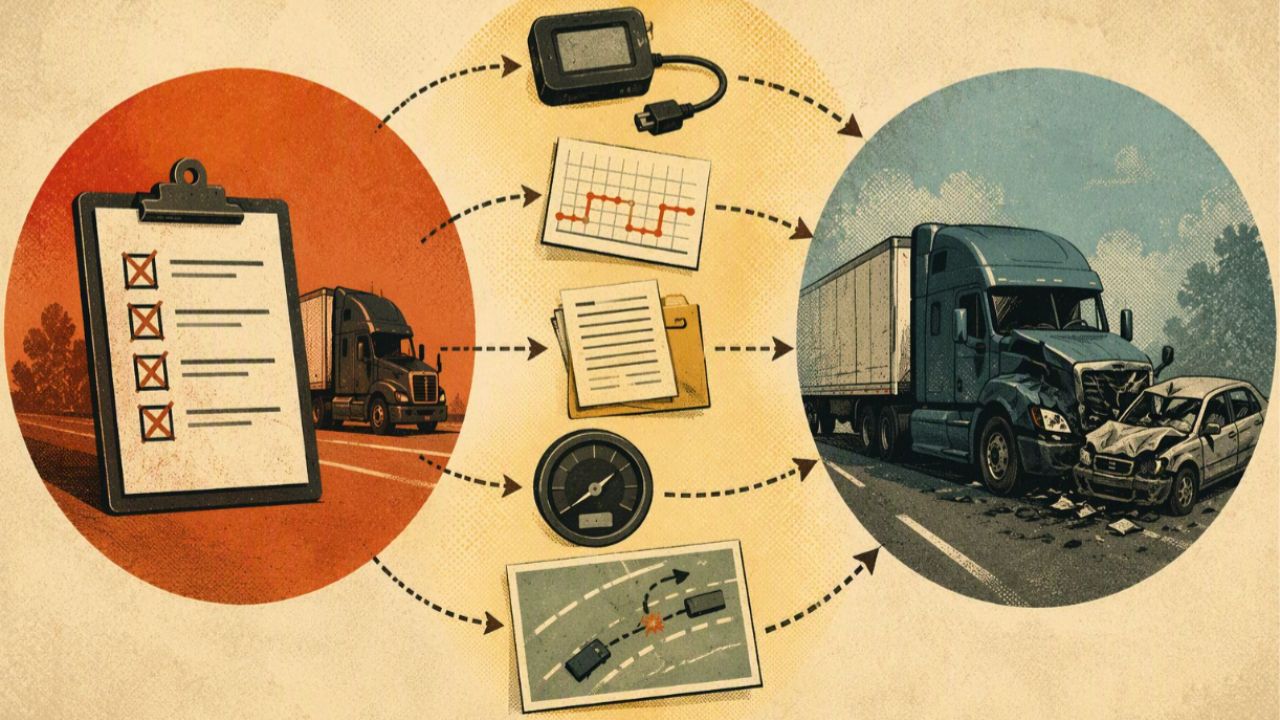
Image provided by Wyatt Law Firm.
Reading the Log Before Drawing a Legal Conclusion
"Hour 12" carries no fixed legal meaning until someone reads the log. It might be a 12th hour of driving, which ordinarily violates the 11-hour rule. It might be the 12th elapsed hour of a shift with only nine driving hours recorded. It might be lawful driving under a properly documented adverse-conditions extension.
The record decides which. Drivers facing a citation, employees disputing a termination, and people injured in a commercial-vehicle collision should treat electronic data as perishable and seek counsel admitted in the jurisdiction handling the matter.
Preserve the unedited log, the driver's annotations, and the dispatch messages for the trip before the retention period expires or the data is overwritten.
Members of the editorial and news staff of Law&Crime were not involved in the creation of this content.






Comments