
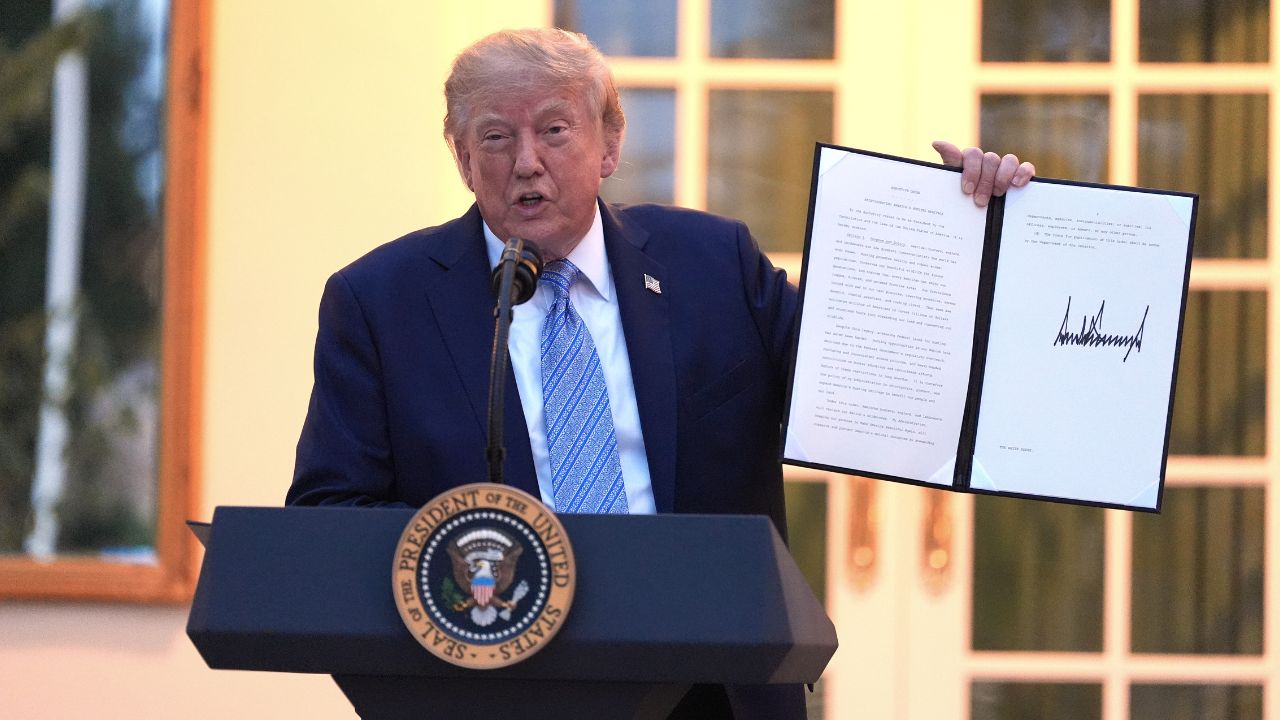
President Donald Trump displays signed orders during a dinner in the Rose Garden of the White House, Thursday, Sept. 17, 2026, in Washington (AP Photo/Alex Brandon).
The Trump administration violated a court order in yet another lawsuit challenging President Donald Trump's efforts to federalize mail-in voting systems, according to a recent filing in federal court.
"This is not an ordinary civil case," the filing reads. "It is a challenge to an Executive Order that attempts to remake American elections by executive fiat, as well as actions to implement the Order that—if left unchecked—will have widespread and pernicious consequences for American democracy."
In a motion requesting a new court order, Democratic Party plaintiffs say the U.S. Postal Service (USPS) acted in violation of the earlier order by failing to provide information about the implementation of "State Citizenship Lists," or lists of voting-age citizens in each state.
Those lists were required by a section of Trump's executive order on mail-in voting issued in March. To date, most litigation challenging the order has focused on a different section of Trump's order: the directive for the USPS to exert control over ballot mail.
In the present litigation, which is actually three separate lawsuits consolidated into the same case in Washington, D.C., the court has also expressed some concern over the citizenship list directive.
During a preliminary injunction hearing in May, U.S. District Judge Carl Nichols, a Trump appointee, instructed the USPS to provide updates when "anything even approaching a material change in the factual scenario on the government side" occurs regarding the lists.
Now, the Democratic Party plaintiffs are crying foul.
The filing takes note of a recent whistleblower report alleging the Trump administration is, in fact, moving forward with such lists.
"For example, a DHS official anonymously reported to Congress that agents have been ordered to collect information from State voter roll databases directly, even if it means illegally disguising their identity," a footnote on the report reads. "DHS did not deny these facts and stated only that it is committed to carrying out the President's agenda."
Moreover, the plaintiffs say the government is now expressly denying there was any such obligation with regard to the citizenship list issue.
"[T]hroughout this litigation, Defendants have repeatedly shirked the Court's instruction, and now in their response they contend there was no obligation whatsoever," the motion goes on. "This ignores the Court's clear expectation, and Defendants' evasive actions have forced Plaintiffs to litigate this extremely important matter on extremely tight timelines and with incomplete information."
The government's latest filing frames the obligation as follows:
[T]he Court has twice declined to phrase its expectation to receive material factual updates as a court-ordered legal obligation. To be clear, the procedural distinction between a court-ordered legal obligation and this Court's stated expectation … has not in any way informed the government's efforts to meet the Court's expectations (to say nothing of the candor obligations that always apply in all cases). Defendants have complied and will continue to comply fully with the Court's stated expectations, even where (as here) those expectations are not formally styled as court-ordered obligations.
The Democratic Party plaintiffs, however, view Nichols' instructions in a far more stringent light. During the aforementioned hearing, the judge told the government it should take a "capacious interpretation of what the [Court's] expectations are," the motion notes. The judge went on to say he "expect[s] the government will comply."
The motion goes on to relay several instances in which the government acted on Trump's directive without prior notice. The filing also details instances in which notice was given on the same day an action was taken. The plaintiffs' implication seems to be that the government has not provided timely progress reports.
"Defendants' approach all but guarantees that Democratic Party Plaintiffs will begin suffering injuries before they can obtain effective relief," the motion continues. "If Defendants only notify the Court about their implementation of Section 2(a) when they are on the cusp of disclosing Democratic Party Plaintiffs' confidential information, it will be extremely challenging for Plaintiffs to obtain relief before their confidential information is disclosed."
In the case, as well as two other cases challenging the executive order out of Massachusetts, the ballot mail rule has been blocked by way of injunctive relief. No such injunction exists for the list section.
The plaintiffs say this state of affairs requires quick action "given the rapidly approaching November midterm elections."
"This Court recognized that reality in its repeated and unambiguous instruction that Defendants should promptly provide notice of any material changes," the motion goes on. "The Court should now enforce those directives and require Defendants to provide a complete disclosure of the status of their implementation of [the list directive]."



Comments